
Rating: 🍿🍿🍿.5/5
When I first heard about this film, I expected it to be very similar to other modern biopics like Jobs (2013), Saving Mr Banks (2013), or The Theory of Everything (2014), focusing on the extraordinary tale of one person and their contribution to the world as we know it. I expected to leave the film amazed at the incredible visuals, the uncanny likeness to Freddie Mercury, and the clever use of music – and at a film that tells us more about an incredible man, whose life battling AIDS was very, very private.
Yet, I walked out of the film disappointed. That’s not to say that the film wasn’t good. There were moments that I thought were brilliant, but I’m not sure I would purposely go back and watch it again. For most of it, I felt like I was watching an extended music video. The film lacked in story, and the music was certainly overused.
One of the brilliant things about movies and television is how they can make you really feel something. The combination of a particular image with a specific piano score can evoke one, or multiple feelings such as happiness, sadness, or nostalgia.
A perfect example of this is in Saving Mr Banks:
The instantly recognizable piano score of Chim Chim Cheree, combined with the ‘Winds in the East’ speech, is one of the best examples of how the creative direction and musical score can work in unison to evoke such feelings.
The score is stripped back to be just a piano playing the melody of one of the most notable songs of the Mary Poppins film. The lack of other musical instruments, added riffs and accompaniments, allow the score to be more impactful, creating a beautiful opening and ending to the film, that leaves you teary-eyed and emotional, as you remember your own childhood and the things that you miss.
For Bohemian Rhapsody, a movie that documents the life of one of Britain’s most iconic and legendary performers of all time, I expected the film to do something similar. To use creative direction and music to touch the emotions of the audience, to not only remember that man that the world lost but to honour him.
Instead, it was as if the director was attempting to fill the lack of movement in the script with as many Queen songs as possible, in the space of two hours. The majority of the movie is about Queen and their pathway to fame. Nearly every other scene has the band in the recording studio and documents them writing songs in a way that is nowhere near realistic.
Anybody who has ever written anything creative – songs, poetry, fiction, etc. will know that you don’t just have an idea for something, write it down, and that’s that. You work for months, sometimes years, on one project, until you have it exactly the way you imagine it. Writers know that the majority of writing is re-writing. You hate one line, so you change it. And then you hate that, so you change it again. And you keep changing things until you create something so completely different from the idea that you started with, that you end up with something that you love.
But for Queen, in the film, writing songs is as easy as blurting out lyrics. Whatever they say in the moment becomes the final song. There is no changing of lyrics. There are no rewrites. There was no “I hate this melody”, “I don’t think that works”, or “Let’s start this from the very beginning.” They simply churn out albums like a popcorn machine pops kernels.
However, just after Freddie is diagnosed with AIDS he is staring at himself in the mirror, as he examines what is left of himself, knowing that he is going to die from the disease someday, if not very soon. As he stares at himself, a stripped-down version of Who Wants To Live Forever (those specific lyrics) starts playing in the background. This combination of him looking at himself, knowing that his time is limited, and the lyrics and melody of the song, brought a tear to my eye and goosebumps to my skin; and is one of the only moments in this film that has resonated with me, long after the credits rolled.
For a film set within the 1970s and 80s – decades which are known for their promiscuity, such as heavy drug-taking, drinking, and sex, I was expecting there to be multiple, and possibly graphic, sex scenes. Yet, for a film that documents the edgy years of modern society, the edgiest parts of the film are comprised of the drug taking at parties, drinking (which features quite heavily throughout), smoking, and the use of strong language; and several racial slurs. Needless to say, I was pleasantly surprised.
Albeit, one of the most astonishing things about this movie is Rami Malek and his incredible likeness to Freddie Mercury. In a movie that is mediocre for what it is, Malek is an absolute star. Throughout the film, he delivers golden nuggets of one-liners such as “I pity your wife if she thinks that six minutes is forever” (when referring to the song Bohemian Rhapsody), which not only makes the audience laugh but captures the charming, lavish persona that was Mercury.
Yet, throughout the film, there is an overwhelming sense from the audience, that they long to discover who Freddie Mercury was as a human being, not just as a performer. I expected the film to boldly go where no filmmakers have ever gone before, and explore in more depth Freddie’s personal life, such as his closeted sexuality, his hedonism, and his off-stage persona. In a generation where film, television, and media are openly discussing subjects which were previously considered taboo, the film could have been a groundbreaking opportunity for its creators to have generated awareness and educated audiences on HIV and AIDS, as well as put into perspective just how far medical research and treatment has come for these diseases over the last thirty years. Yet, the film merely alludes to the fact that Freddie has AIDS when the audience sees him talking to a doctor in the hospital and sees other sick men with the disease. But not once, are the words “You have AIDS” ever spoken.
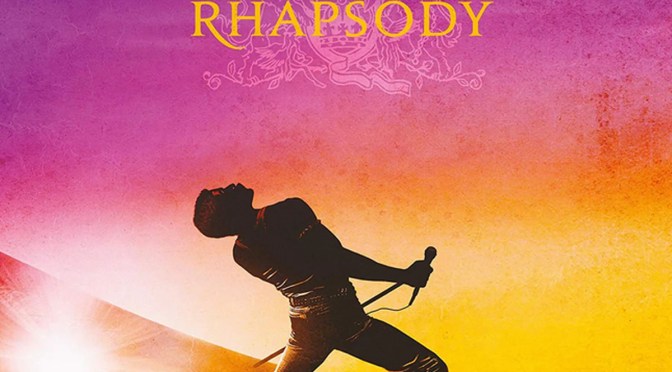
Though, despite this missed opportunity, Malek’s performance as Freddie really comes to life, during the final scene of the film, where Queen is performing at Live Aid in 1985. Every movement that Rami Malek makes, every step, every turn of his head, and every facial expression is uncannily similar to that of Freddie Mercury, and it is clear that Malek spent countless hours studying everything about the legendary performer.
The film lacks in multiple aspects, for the most part perhaps because of the change in director halfway through production, the lack of story in the script, or the overuse of music. More could have been done with the musical score and creative direction to evoke an atmosphere and create moments throughout the film that resonated with a nostalgic, emotional audience; and the filmmakers missed an opportunity to create a platform for the discussion of sexually transmitted diseases. However in what is an average film at best, Rami Malek’s uncanny performance as Freddie Mercury is exquisite, and it is almost impossible to envision anybody else fulfilling the role like he does – particularly in the final moments, as he performs on stage as Freddie during Live Aid 1985, which is by far the most brilliant and powerful moment of the whole movie.
Release Date: 24 October 2018
Director(s): Bryan Singer, Dexter Fletcher
Distributed by: 20th Century Fox
Run Time: 2 hours 14 minutes
Starring: Rami Malek, Lucy Boynton, Gwilym Lee, Ben Hardy, Joe Mazzello, Aidan Gillen, Tom Hollander, Mike Myers
 thebecksedit.co.uk