
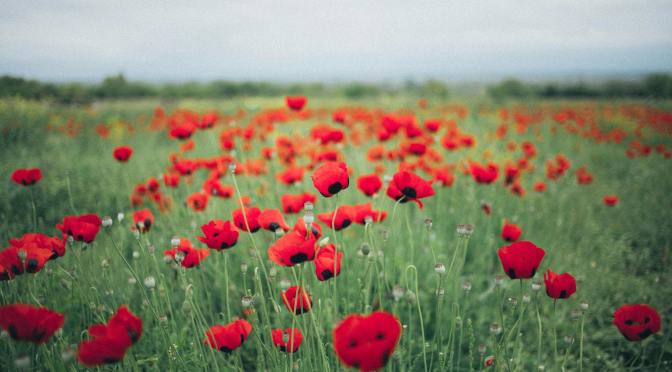
Red. Scarlet Red.
Like the colour of their blood.
A horror, lies in Flanders Fields,
between the rows of us.
We ask not for mercy,
just to remember what befell,
and through the sea of ruby red,
a story we must tell.
We are a mark,
a reminder,
a memory,
telling tales of courage
and men who paid their debt.
And beneath the days of golden rays,
we vow: “lest we forget.”
Category Archives: General

Writing Challenge: Forbidding the letter “A”
I love writing challenges. They’re a great way to stimulate your imagination, practice your skills, and encourage creative thinking. For me, I find them especially useful if I hit writer’s block, as although they impose restrictions in one aspect, I can write freely in others–and usually what I end up producing is something unexpected, but often useful.
Recently, I challenged one of my best friends, Isaac, to write a short story without using the letter “A”, and wanting to exercise my own writing muscles, I decided that it was only fair that I, too, take on the challenge. Here are a few things I learnt:
- We use more words containing the letter “A” than we realise. I would estimate that 90% of our daily language consists of sentences with words including this letter–from conjunctions and nouns, to verbs and adjectives. And trying not to use any words with this letter is a complete and utter mission. Forbidden words include: ‘a’, ‘an’, ‘am’, ‘as’, ‘at’, ‘are’, ‘was’, ‘also’, ‘can’, ‘what’, ‘had’, ‘have’, ‘said’, ‘any’, ‘say’, ‘that’, ‘than’, ‘all’, ‘again’, ‘back’, ‘because’, ‘about’, ‘make’, ‘take’, ‘way’, ‘want’, and ‘after’.
- Trying to construct a complete, concise sentence without using the letter ‘A” is hard. There are so many things that you want to say, that you want to say in a specific way, but you just can’t.
- You have to be clever. So, I can’t use ‘I have’, but I can use ‘I’ve’. I can’t use ‘and’ but I can end sentences and begin new ones. I can’t use ‘a’ but I can use ‘the’. You have to be extremely selective with the words you use and how you use them.
Here is what I managed to come up with:
The lights in the house flickered one by one,
the silence creeping in through every sliver.
Somewhere beyond the river, the trees,
owls cooed, wolves howled,
wind whistled in the breeze.
The boy knelt, keeled over, wheezing,
the glistening pools of liquid ice, quickly freezing
below his feet.
The chill enveloped him, like piercing knives deep into his spine,
the whine, the whine of piercing cries, echoing.
‘I come in kindness,’ the voice whispered.
‘Lies,’ the boy replied. ‘You do not seek good.’
The boy hiccoughed, sobbing into his shirt,
sodden with dirt.
‘My mother is gone. My sister too. You took them from me.’
‘They left willingly.’
‘More lies,’ the boy replied. ‘You took them in the night. Destroyed their minds. Twisting, turning their thoughts into fictions where they felt they could not go on. You left me on my own.’
‘Their choice.’
‘More lies. You do not know freedom. You simply collect souls until your collection is complete.’
‘My boy… it is not my choice. I follow orders. My list of souls… it differs every week. Some slither into the ether, where I struggle to find them. Others seek me out like I seek them.’
‘But…’
‘Hush, boy. Do not worry. It is not your soul I’ve come to collect.’
‘If not me… then who?’
The voice did not reply. The owls cooed; the wind whistled; the wolves howled. Silence surrounded the boy once more. From the house, the lights flickered out of control–more quickly with every second ticking by, before stopping swiftly.
Then, he felt it deep within his bones: the blood-curdling cry… the sound of the voice collecting his next victim.
What do you think?
In my opinion, it’s not bad. It’s not great, but considering the multitude of words I couldn’t use, I’m quite happy with it! I may have to have another go at some point in the future, perhaps writing something a bit more upbeat because this took an awfully dark tone which was unexpected… but then, I guess that’s the beauty of these challenges because you never know what kinds of things you’re going to end up creating!
Why don’t you have a go at this challenge and see what you can come up with? (And if you do, please tag me in your posts, because I’d love to see them!)
NCIS: Tony and Ziva: Action-packed, Romantic and Charmingly Persuasive.
So, it’s officially been over a week since NCIS: Tony and Ziva premiered, and truth be told, I’m still processing. I’ve had every single episode on repeat multiple times since 4th September, so much so that I have almost every single scene fully etched into my brain. I’ve watched all four episodes at least six or seven times already because I just can’t get enough – give me a few weeks or so and I’ll very likely be able to recite them all from memory.
As a long time Tiva fan, I had high hopes for this show, as I am sure most of us did, and it’s safe to say that it has already surpassed every expectation. It is far more than I could have ever wanted and wished for, and there are still six episodes to go. Four episodes in and this show is knocking my socks off in ways I couldn’t have imagined. There’s plenty of romance, epic action sequences – car chases, fights and even self-driving killer automobiles (no, I’m not kidding!), and the humour is absolutely spot-on with some of the best one-liners I have ever heard in a show. With quotes like “Does a babushka wear a headscarf?” and “We have friends and family at this wedding. They’re pathetic and fragile,” I have lost count of how many times I’ve cackled out loud, and I find myself grinning ear-to-ear with every episode.
Before the show premiered, I was unsure as to what to expect going into it. With Tony and Ziva being transported into an entirely new setting, it was easy to worry that the chemistry and magic that made them so brilliant on the mothership wouldn’t be the same. But there’s no reason to fear. Their chemistry is undeniable and better in a million and one ways. Everything that made them exciting to watch on the mothership is ever present and in full force, and their spark is sizzling hotter than ever.
I absolutely adore the fact that this show has broken the classic NCIS formula of episodic procedural, and instead allows for a deeper exploration into the relationship between these two characters; something which fans were pleading to have for decades. The flashbacks execute the ‘filling in the gaps’ perfectly – allowing us to see their life as a couple after Ziva reunites with Tony and Tali in Paris, and they slowly reveal what happened with their relationship (and the reason why it broke down), until we find them where they are today: on the run.
You’re probably asking: well, just how different is it to the mothership? The answer: very. The ghastly tangerine walls of the Navy Yard squad room have been replaced with the most beautiful European backdrops, which only serve to enhance the beautiful storytelling and exceptional writing. It’s true, the show is more romantic spy thriller than crime drama, but it is in the best of ways. There is something in this show for absolutely everyone, whether you’re a long time fan or a newcomer being introduced to these characters for the very first time (and if you are brand new, don’t worry – there’s an incredible montage at the beginning of episode 1 to bring you up to speed with the intricate history of these characters.)
If you’re a lifelong ‘Tiva’ lover as they are so eloquently named and the original show stopped feeling like your NCIS after they left (as I read in one review), then this show is without a doubt, 100% for you. Tony and Ziva are still Tony and Ziva, but are supported by a wonderful ensemble of new characters that are so easy to fall in love with. It’s action-packed, romantic and charmingly persuasive, and it truly feels like they’ve captured lightning in a bottle.
[I’ll also be breaking down every individual episode with my thoughts – as when I my brain starts functioning again!]
Where Have I Been? (Again)
If you read my post in March about where I’ve been, you’ll know that I vowed that this year I was going to post here regularly… and well, I don’t need to tell you that I failed miserably!
Actually, failed probably not the right word, as I truly believe that if you’re trying then you’re never failing. If you’re trying, you’re learning. If you’re trying, you’re growing. And growing is never failing.
But sometimes life just gets on top of us. Life gets busy and other things take over and we just don’t have the time or the capacity to post as much as we want. And other times, we lack creativity. I know that the latter has been a problem for me in recent months. I’m innately a creative person, but when things start taking their toll, or I lose grip of my work/life balance, I find that my creativity is stifled.
Sure, I could probably come on here and write about anything. But I don’t want to post something just for the sake of it. If I’m posting something here, I want it to be meaningful, insightful, or useful in some way. I want it to be personal and have thought behind it.
And what could be more personal to me than NCIS: Tony and Ziva premiering next week?! (Next week! Where did that time go?!)
Thus, I am reviving this blog as I’m truly hoping to do a review/breakdown of each episode and talk about my favourite moments. Whether or not that will actually happen, I don’t know, because it’s very possible that this show will melt my brain in the best way. This is literally a dream come true for the teenage fangirl inside me – for the sixteen year old who spent hours crying over the episode Past, Present, and Future because she was losing the one ship she adored most in the world.
So, whether you’re just browsing, or you’re here to keep up with my Tiva posts and anything else I might have to share – welcome… again.

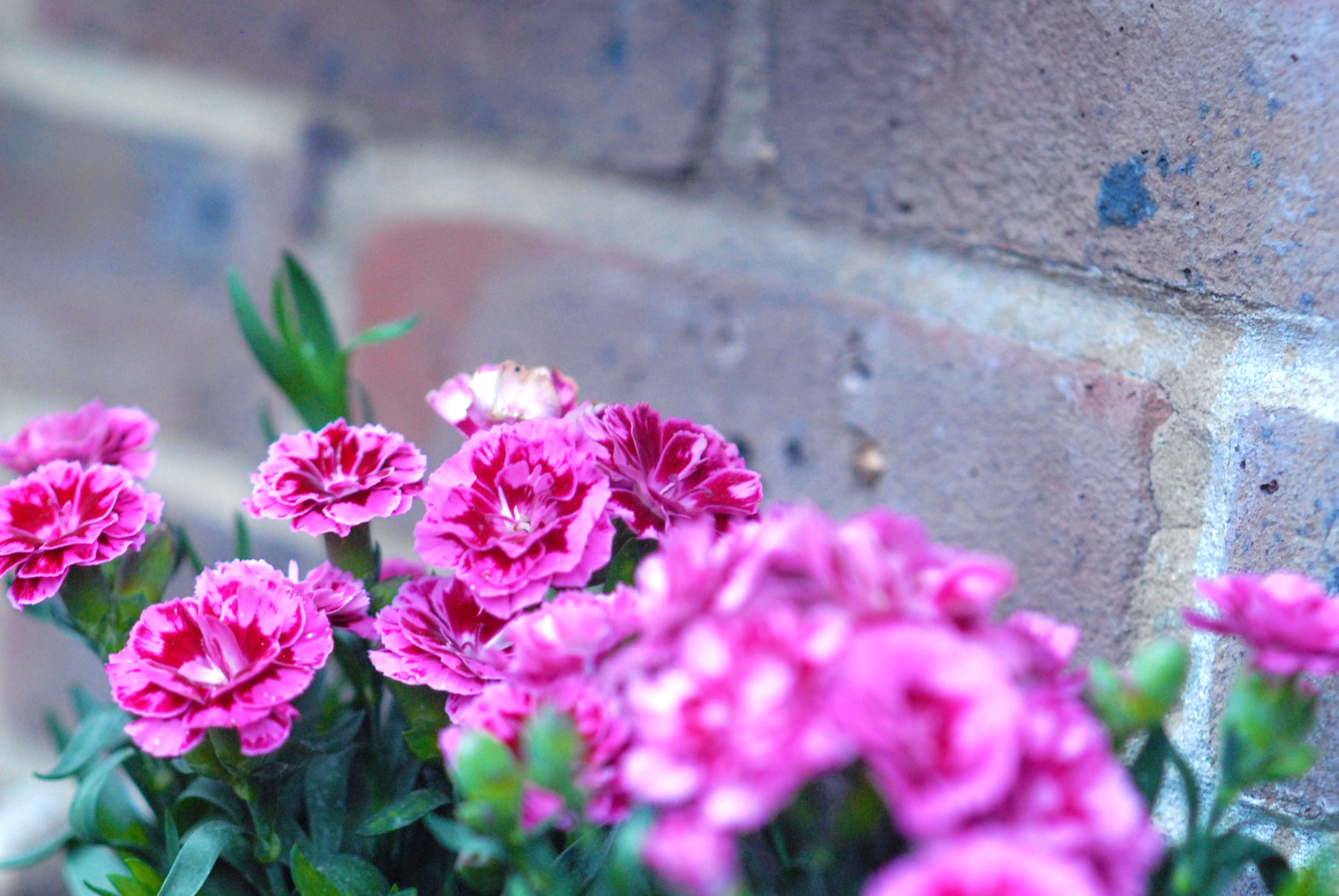
Summer Blooms!













Eclipse
Two halves
dark and light
finally equal
for the first time.

Abyss
You’re surrounded
covered by darkness
like a blanket
but it is not warm
or comforting.
It is cold,
like shards of rice ripping through your skin
deeper and deeper into your soul
drawing you in
until the light fades
and is replaced
with the nothingness,
the abyss.

Dental Anxiety
I have the dentist today and the truth is, I hate it. I hate everything about going. Don’t get me wrong, my dentist is lovely and couldn’t be nicer… but the actual act of sitting in the chair and letting them poke around in my mouth is such a vulnerable and uncomfortable feeling for me.
I am filled with so much anxiety during the days beforehand that I barely eat, and I’ll be lucky if I get a couple of hours sleep. Usually, there’s nothing wrong. The check-up goes swimmingly, and I don’t have to see them again for six months. He tells me to lay off the sweets (oops – I do have a sweet tooth) and be mindful of how many fizzy drinks I consume (also a downfall – I love Pepsi Max) and to be sure that I’m brushing twice a day (I’ve only missed it once when I was utterly exhausted and fell asleep on the sofa thirty minutes after getting home, when I didn’t resurface until nine hours later.)
And yet, despite having had actual dental work done before – i.e a filling, which in hindsight wasn’t nearly as bad as I had been imagining it for my entire life… my fists still clench and my toes still curl for the entire five minutes I’m sat in the chair when he tells me that my mouth looks fine.
But, I know that I am not alone. Over 53% of Brits have some level of fear and anxiety about the dentist. There are millions of people out there who feel exactly the same way I do – perhaps because they’ve had a bad experience that essentially traumatised them for life (I did), or maybe because they’re ashamed of what their mouths/teeth look like as they haven’t taken proper care of them, and they’re worried about the dentist judging them (they should never judge – they’re there because they want to help you!) Either way, this feeling isn’t rare. It’s entirely more common than any of us think.
As I sit here and try and work, I can feel the anxiety severely setting in, and I’m a bundle of nerves. I know that in reality, it’s not going to be nearly as bad as I am imagining. I know that things are probably going to be fine – and even if they’re not, I have made it through a filling before. I know that I am capable of sitting there for however long it takes, listening to music while they drill and fill. I hope it doesn’t come to that, but I know it’s nothing I cannot handle.
So, if you’re reading this and you too are suffering from dental anxiety, please know that you are most definitely not alone. I see you. I feel it too. We are in this together.
Update: as predicted, everything was fine and I don’t need to go back for six months!

Where Have I Been?
Hello. It’s been a while.
You’re probably wondering where I’ve been? The truth is – nowhere (and everywhere!)
Back in August 2023, I enrolled as an apprentice on the Level 3 Content Creator course – something which excited me greatly. If you know me, you’ll know that I love learning new things and I’m an immensely creative individual, and so the course sounded like the perfect development tool for myself – and it was! I learned so much about creative process such as editing, videography, how to create content for social media, how to optimise blog posts, and more. But, even though it is a course that I completed alongside my full time job (i.e within work hours), I found that doing both was utterly exhausting, which meant that I didn’t have the motivation for much else after I finished work, despite trying very hard. I mean, I only read five books last year – a whopping 45 less than the year before, and 95 less than the year before that!
That being said, I did try to keep up with posting on here and on Instagram as best as I could, but with very little happening in the way of reading, I haven’t had much to post over there… and trying to find the time to finish the 68 blog posts that I have in my drafts has been challenging. Even more so, when I haven’t had the inspiration to write. And when it comes to creativity, inspiration is everything.
But, I really love this blog. It is a place where I can be authentically myself, and share things that I enjoy, that inspire me, that I want to recommend to other people, and dive into my innermost thoughts, or ponder about the world. I have so many things to share and say, even if I haven’t posted them yet, and I really want to make a commitment to not let this blog slip through the cracks again, because I think it could really be something special if given the chance.
Which is why I am going to make a vow: that I will post something every fortnight. It doesn’t matter what it is, so as long as I am posting regularly. Perhaps it will be as simple as a thought that has been on my mind, or a piece of advice I want to share with people. Or maybe it will be an in-depth review of a product I’ve tried, a film I’ve watched, or a television series I’ve been binging. Maybe I’ll share some of my long lost writing that has been tucked away in my google documents for years. I don’t know what I’ll share – but that means we all get to be surprised!
What I do know is that at the top of the list of things I’ll be sharing soon will be: an updated review on Daisy Jones and the Six (the series), which I finally completed; some travel writing of my trips to Spain and Morocco – such as recalling my experience having my very first Hamam massage; several book reviews of things I’ve actually read recently; and more.
So, whether you’re a long time reader of my blog and have been here since the beginning, or you’re just tuning in for the first time – welcome. I hope we have some fun here together. :)

‘Rent a Friend’


Yes, this is as crazy as it sounds… or is it?
The need for companionship is an innate human desire. We long to be with others–from sharing coffees, spinning yarns, sitting quietly in rooms together scrolling through our phones, or simply doing nothing. We crave contact, and yet, loneliness is a growing epidemic. (Between 2022 and 2023, nearly 1 in 4 adults reported feelings of loneliness.)
We see it all the time on social media–people posting perfectly edited photographs with their friends, living it up large, and showing how happy and enriched their lives are. (But are they? Remember that what you’re seeing on social media are only very small snapshots of people’s lives, and may not be the whole truth. After all, a filter can hide a multitude of sins.)
But sometimes we want to be the ones posting our adventures to the ‘gram… but people are busy and don’t always have the time. And, there are many people who do not feel comfortable going solo.
The solution: ‘Rent a Friend’ for any occasion! Wedding plus one? Sorted. Vacation buddy? Done. Theatre, movie, or dinner companion? Bingo. Don’t want to go to a concert alone? You’re covered.
How would it work? Well:
- It would be app based, with people signing up on the understanding that they would be renting someone’s time, or being paid for their own.
- People would choose their preferences—i.e. what occasions they’re willing to be a companion for – concerts, shows, dinner etc. Geographical preferences would also be available, as well as linking to social media accounts to find people nearby/shared acquaintances with friends…
- The person who is looking for a companion would upload their ‘upcoming event’ and others would swipe ‘yes’ if they would be willing to attend. The uploader would then be able to look through the responses and choose their friend.
- Once matched with a friend, the two people – the uploader and the responder – would be able to converse with one another, finding out a little bit more (interests, background etc.).
- Once the event is over, the uploader would have the option to confirm that the responder attended the event with them. The responder would then get paid.
And that would be it!
Of course, there are some drawbacks. The idea of paying someone for their friendship is probably not appealing to many people. But, then again, would the security of knowing you have someone to do things with be worth overlooking that? After all, if you knew you were getting paid to go to an event, would you cancel?

What would you do if you won the lottery?
What would you do if you won the lottery?


Not tell a soul, and then do good with it. (Of course, this is all on the basis that I would win big on the lottery – millions, and not just a small amount).
The problem with people acquiring money is that others perceptions of them change. Fake friends come out of the woodwork looking to scrounge and sponge off them. Others would expect things of you – ie. if their car has broken down, they’d hope you’d pay for a new one because you’re now rich. You would become the object of people’s affections for the wrong reasons. You would no longer be you. You would be the richer version of yourself – with all the labels that accompany it. Thus, I would not tell a single human being, unless absolutely necessary (ie. accountant).
I would invest it practically – buy myself a house in cash, so I wouldn’t have to pay a mortgage. Equip said house with furniture and decorate to my tastes. I’d buy a new car outright, so I wouldn’t have to pay to loan or lease one. I would invest money into my pension. I would set up a trust/inheritance for any future children I may have. I would also set my parents up for the rest of their lives so they would not have to worry about their pensions.
It is only the people who truly care for you, for whom you truly care for, to which money would not make a difference – you would still be the same person you were before. It is to these people whom I would give a fair portion – my family and true friends… enough to make sure they’re comfortable and can afford some luxuries.
After that, I’d jet off and see the world for a few months – Canada, USA, Japan, Thailand, Australia… all of the expensive places. I would take my parents with me, of course.
I would give another good portion to charity – Cancer Research, the Alzheimer’s Society, and any others I may feel I need to make a donation to.
Then, I would open the bookshop/cafe I have always dreamed about owning – chic and classy, and full of hopes.
The remaining money (if there was any left), I’d keep for a rainy day.
And, after all that, I’d go back to work like normal. Just another day at the office.

If you could un-invent something, what would it be?
If you could un-invent something, what would it be?


Nothing.
Every invention paves the way for something else. It ripples throughout time. Nothing is ever really ‘new’ because the foundations of which it is comprised, are rooted deep within the past. If you were to un-invent something, who knows what our lives would look like.
The 2019 film Yesterday is a very good example of this. It’s a film that explores an alternate universe where The Beatles never existed, and the truth is: our culture and entertainment would look drastically different if they had never been. Harry Potter would not exist, nor would a million other things.
I wouldn’t un-invent anything because every invention is the foundation for another.
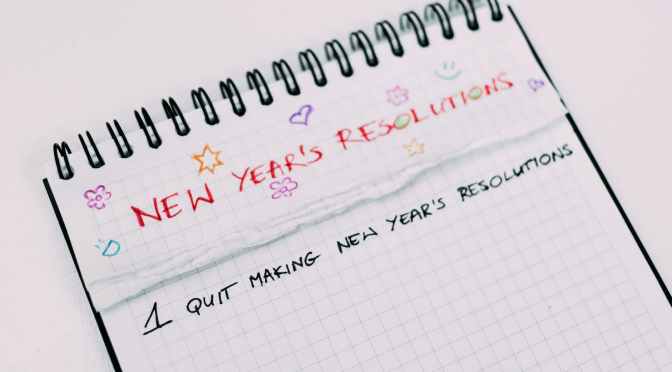
Saying ‘no’ to the New Year’s resolutions!
It’s hard to believe that another year has come and gone so quickly. It feels like only mere days ago that I was celebrating Christmas 2022, and heading into 2023, with my friends and family!
I got asked recently was whether I am making any New Year’s resolutions, and the answer is: no.
I’ll be the first to admit that I’m not a fan of making resolutions–mostly because I find it hard to keep them. I feel like the term ‘resolution’ has so much weight and pressure attached to it that when/if you fall off the wagon or don’t stick to the resolution, then it feels almost shameful. But, isn’t that the opposite idea of what resolutions are for?
New Year’s resolutions are a tradition that have swept across the Western World, with people making firm plans of things they’re going to quit or things they’re going to do for the new year ahead. And, it might seem like a relatively modern idea, but the custom has been around for centuries; although it hasn’t always looked the way it does today.
It is said that the ancient Babylonians were among the first people to make New Year’s resolutions, a mere 4,000 years ago (4th Millenium BC – 3001 BC). During a large-scale religious festival known as Akitu, the Babylonians would crown a new king and reaffirm their loyalty to the monarch. They would make promises to the gods to pay their dues and return things they had borrowed to their rightful owners. If they kept their word, the pagan gods would then bestow favour on them the following year.
A similar tradition also roots itself in ancient Rome, after Julius Caesar altered the calendar and established 1 January as the beginning of a new year, circa 46 BC. (Which is why most of the modern world follows the Julian calendar…). They named January for Janus – a two-faced god, who had special significance for the Romans. They believed that Janus symbolically reflected on the previous year, and simultaneously into the following year; thus, the Romans offered sacrifice to the deity and made promises of good conduct.
For early Christians, January 1st became the traditional day for thinking about one’s mistakes and resolving to do better in the future. Although today they remain a mainly secular practice, and instead of making promises to a deity and other spiritual beings, people mostly make promises to themselves to focus on self-improvement, which is why it can be so hard to keep them.
I am, in fact, one of those people that finds resolutions hard to stick to. Perhaps it’s because I am too hard on myself when I slip up, or perhaps it’s because I make resolutions that are simply too hard to stick to in the first place and don’t allow myself any leniency, but in all the years that I have made them, I have never stuck one out for an entire year. I think the most I have ever gone is a few months, and then my birthday rolls around in April and it’s like the resolutions never existed!
That being said, I do make goals, as I’m sure most of us do. They’re positive and essential for progress–both personally and professionally–and I would find it weird and somewhat off-putting if somebody didn’t make any goals in their life. (I’m not saying that you have to list them all down like I do, but not having any at all screams lack of ambition to me.)
But, I also find that people aim too high with their goals. I’m not talking about the big dreams, though that is a part of it. I’m talking about the goals leading to the big dreams. People get so focused on the endpoint – where they ultimately one day hope to end up. They bite off more than they can chew, and give up on the dream because they feel it’s unattainable. Say, you dream about writing a bestselling novel. You dream about walking into a bookshop and seeing your work on the shelf. That’s the big dream. But what are the smaller goals to get there? First drafts. Second drafts. Final drafts. Sending work for agents and publishers. Publishing something else independently to get your name out there. Writing something new, finishing it, and sending it to other publishers. All of these smaller goals are as essential as the dream. The small milestones make the big dream possible.
This is my big dream: to walk into a bookshop and see my book on the shelf or on a stand; to see people posting reviews about it on their Instagrams. But this is not something that is going to happen overnight. It is not something that is going to be handed to me on a silver platter. It is going to take work. And, a lot of working towards smaller goals to reach the dream.
If you’re feeling overwhelmed with a large goal that you have set your sights on this year, don’t panic. Try breaking it down into smaller, more bite-size, manageable ones. Work towards those. And before you know it, the big dream will only be a few small steps away.
Of course, if you’re reading this post, then you’re probably wondering about the goals that I have this year. Well, without further ado, here they are:
- Be healthier and fitter. Do I want to have a body that I feel comfortable posting in a bikini? Yes. But that requires work, and change will not happen overnight. My smaller goals are to go to the gym, and try to be healthier than I currently am. But I’m not going to chastise myself if I fall off the wagon. I mean, when PMS hits, am I going to have six million spoonfuls of ice cream to make myself feel better? Probably. But, my body is literally bleeding for seven days out of a month… give me a break.
- Finish my manuscript. I originally said that I would have finished my book by the end of December 2023, and I wholeheartedly intended for that to happen. My plan was to spend the week between Christmas and New Year knuckling down at my laptop and rewriting and making all the final edits. But, I came down with a cold and felt absolutely rotten. I could barely breathe, my eyes were watering all the time, and the sneezing was uncontrollable. And I know in myself that when I don’t feel the best, the work I make isn’t going to be good. I’m not going to be thinking clearly, and I’ll only half-arse it. And my book deserves more than that. But, I will finish my manuscript this year–hopefully on my birthday, as I started planning it in April 2023. (I say hopefully because I keep thinking up more stories to include, and it keeps getting longer and longer.) However, if I don’t make that deadline, I’m not going to be too hard on myself. The book will be done when it’s done; when it feels complete.
- Write more. This probably seems self-explanatory, but I haven’t really written much of anything else since I started working on my manuscript, so I’d like to switch it up and write something new, even if it’s just for fun, and even if it’s only for myself. Exercising a skill is essential.
- Try to make a dent in some of the books on my shelf. It’s overflowing, and I barely read anything last year. I’d like to actually get through at least a third of all the books I own, and one day when I live in a grand mansion with my Beauty and the Beast style library (with the rolling ladder), I’d like to say that I’ve read most of them.
- Do more things. I only saw four theatre shows last year, which is shocking for me, as I used to go to the theatre all the time. I love watching plays and musicals, so I can’t wait to get back into the audience and watch some spectacular things. I also now work in London twice a week, so there is no excuse for me not to see things when I am there so conveniently. But, I’d also like to go to more exhibitions, events, and do other things that interest me. I have my eye on the Van Gogh Experience, as well as Tom Hank’s new exhibition about space!
- Spend less time inside my head. Last year was… interesting for me. I spent so much time wrapped up in my cacophony of thoughts and worries about the future that I couldn’t enjoy all the things I was experiencing. But someone said to me that I’m worrying about things that may or may not happen. And, if they do happen, you’re only putting yourself through it twice. What’s the use in that? Very wise and profound words that I think I’ll actually listen to.
- Spend less money on needless things. I’m sure we all spend a lot of money on things we don’t need–crap that ends up getting piled around the house; coffees we could easily make at home; food we could prepare ourselves. I want to spend less money on the things I don’t need, to spend more money on experiences, holidays, and things I actually want.
- Drink more water. I hate the taste of it, but it’s good for me, and I don’t drink nearly enough of it in a day.
- Learn three new skills by the end of the year. I’ve recently learnt to crochet and I’m having heaps of fun doing it. I’m working on a doggie blanket for my best girl – Vera, a Spaniel (who is not mine, but an utter beauty, and it’s impossible not to fall in love with her), and a beanie for myself! Once I have completed these, I shall also be working on another doggie blanket for one of my best friend’s dog – Ollie (as is his current name, but subject to change), who is a beautiful cockapoo! I have no idea what other two skills to learn, but I’m sure something will crop up that I’ll get hyper-fixated on!
- Go for a walk every single day, even if just for ten minutes. I work from home and barely get out into the fresh air on a day-to-day basis, unless it’s travelling to or from work twice a week. But I’m lacking in vitamin D, and sunlight is good for the soul, so I need to make a conscious effort to, you know… feel it.
Of course, there are more goals that I have set for myself, and I am sure I’ll keep continuing to add to them throughout the year, but these are the ones that I am going to begin with – ones that feel manageable and not overwhelming to me.
Have you set any goals for yourself this year? If not, there is always time. And remember: start small. A small amount of progress in the right direction is still progress.
The Hundred Years War
Much like the rest of the world, since the beginning of October, it has been impossible for me to tear my eyes away from the news. For weeks, the conflict between Israel and Gaza was filling the papers, TV screens, and social media. It shocked and saddened us all. And yet, it is not something new or out-of-the-ordinary.
I never thought I would be posting about geopolitics on here, but it does not feel right to sit here and continue producing normal content without addressing the devastating war. I cannot, in good conscience, sit here and talk about the things I love while knowing what is happening. While knowing that thousands of innocent children and their entire families are being massacred and slaughtered, some families even being completely erased – all in the name of ‘defence’ and Israel’s twisted ideologies.

I’m sure for many of us, up until recently, we had not paid much attention to the citizens of Gaza and their oppression. Perhaps we weren’t even aware it was happening. But the truth is, it has been happening for the entirety of our lives, our parents lives, and our grandparents lives. For the past 75 years, Palestinians have been living under a totalitarian regime, like something out of a dystopian novel, and it shows no signs of wavering.
Yet, the more time that passes, the less attention mainstream media is giving it. My timeline on Instagram is no longer being overwhelmed with videos and infographics. But, the war and oppression is far from over. And I realised that it is up to us to keep the conversation going.
In the film National Treasure, Ben Gates recites a line from the Declaration of Independence that says: ‘Those who have the ability to take action, have the responsibility to take action.’
We have the ability and responsibility to learn about the situation, so we can seek justice and raise our voices for those who are unable to do so. It is the only way things will ever change.
I also recognise there is misinformation being spread about the internet, to the point where people can no longer distinguish fact from fiction. Thus, this post aims to collate most of the essential information on Palestine, its history, its people, as well as the conflict, in order to help those who wish to educate themselves. I have tried my very best to obtain it from reliable, factual sources, but as ever, if you notice there is something incorrect, please let me know so I can correct it.
(You’ll also find a section of infographics at the bottom of this post (along with some scattered throughout), as well as links to resources should you want any more information. There is also a section on charities and organisations and ways you can help.)
A History of Palestine
Palestine (officially known as the State of Palestine) is located in the Southern Levant area of West Asia, bordering Syria, Jordan, Egypt, and the Mediterranean Sea. It comprises two territories – the West Bank (west of the Jordan River), and the Gaza Strip (along the coast of the Mediterranean Sea), and in 2021 it was home to roughly 4.9 million people. (Think just under half the population of London.)
Up until 1922, Palestine resided under Ottoman control and was home to a very small minority of the Jewish population. It stretched from the border of Egypt to the border of Lebanon/Syria and comprised most of modern-day Israel.
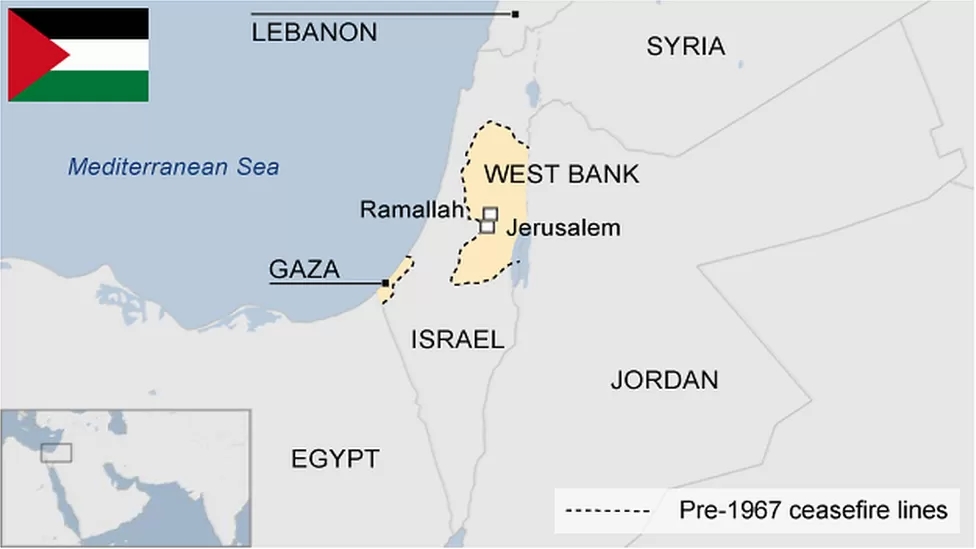
Pre-1917
In 1916, Sir Mark Sykes, a British Conservative MP who had risen to a position of significant influence on Britain’s Middle Eastern policy, and Francois George-Picot, a French diplomat and former consul-general in Beirut, signed a secret consensus approved by the Russian Empire known as the Sykes-Picot agreement.
In it, it outlined their collectively agreed ‘spheres of influence and control’ in Southwestern Asia, including the countries of Armenia, Syria, Cyprus, Palestine, and Kuwait; and was founded on the premise that the Triple Entente (Great Britain, France, and Russia) would succeed in defeating the Ottoman Empire (Turkey, Greece, Bulgaria, Egypt, Hungary, Macedonia, Romania, Jordan, Palestine, Lebanon, Syria, parts of Arabia, and a considerable amount of the North African coastal strip), during the First World War.
It agreed that control of countries would be divided as follows:
- Britain: Coastal strip between the Mediterranean Sea and the River Jordan, Jordan, southern Iraq, and a small section of land that included the ports of Haifa and Acre (now parts of modern day Israel), to allow access to the sea.
- France: Southeastern Turkey, northern Iraq, Syria, and Lebanon.
- Russia: Istanbul, the Turkish Straits (two waterways in northwestern Turkey), and Armenia.
Up to this point, although Sykes had been aware of Zionism (the Jewish nationalist movement that originated in eastern and central Europe during the late 19th century), and was in contact with Moses Gaster, a former President of the English Zionist Federation, no active negotiations with Zionists had taken place.
1917-1947: Palestine under British Mandate
On 2 November 1917, amid World War One, the then British Foreign Secretary Arthur Balfour wrote a letter to Lord Rothschild, a leader of the British Jewish Community, stating that the British government were supportive of the notion of establishing a national home for the Jewish people in Palestine. This statement was published a week later in the press on 9 November 1917 and came to be known as The Balfour Declaration.

On 24th July 1922, the League of Nations adopted a legal document (League of Nations Mandate for Palestine) based on the Sykes-Picot agreement, and other agreements reached at the Paris/San Remo conferences which officially declared Britain as a Mandatory in control of Palestine (which had been under military government – Occupied Enemy Territory Administration South (OETA-S), since its occupation by the UK during WW1). As a result, this led to the domination of the Middle East (Arabian Peninsula, the Levant, Turkey, Egypt, Iran and Iraq) by Western powers, and saw the creation of the modern Arab world and the Republic of Turkey.
The League of Nations document reinforced ideas presented in the Balfour Declaration, noting the aim to establish Palestine as a national home for Jewish people while ensuring that the rights and positions of other communities already in Palestine be respected and preserved, as well as holy places. Article 25 of the document allowed for the British government (with the approval from the League of Nations), to separate the territory east of the Jordan River – a right which it chose to uphold with the creation of the Transjordan Memorandum.
Between the years of 1922 and 1947, under British Mandate, the large-scale immigration of Jewish people took place, mostly from Eastern Europe, with the numbers continuing to escalate throughout the 1930s due to the Nazi persecution of Jews during the Holocaust.
Arab requests for independence, and opposition to the immigration movement, led to an uprising in 1937, followed by terrorism and violence on both sides. However, in 1947, Britain chose to turn the problem over to the United Nations.
1947-1977: The Creation of Israel
Since 1917 with the Balfour Declaration and with the creation of the British Mandate of Palestine, there has been tension and unrest between Arabs, Jews, and the British, in the modern-day Levant. Over the following decades, the waves of Jewish immigration led to a significant increase in the Jewish population in Palestine.
On 29 November 1947, the United Nations adopted Resolution 181 (II) which proposed ideas of ending the British Mandate of Palestine and partitioning it into two independent states – one Arab (Palestinian) and the other Jewish, along with the Special International Regime encompassing Jerusalem and Bethlehem. Palestinian Arabs opposed this as they saw it as a ‘violation of sovereignty’ because it gave away land owned and inhabited by Palestinian people. Conflict broke out almost immediately between the Jewish and Arab populations, with the first act being an ambush of a bus carrying Jewish passengers from Netanya to Jerusalem the following day. As British troops prepared to pull out of the region, conflict continued to escalate.
(It is important to note that although the US had announced support for the Balfour Declaration, President Franklin D Roosevelt had offered assurances to the Arabs in the Levant in 1945 that the USA would not intervene without first discussing matters with both the Jewish and Arab population in the region).
On 14 May 1948, David Ben-Gurion, the head of the Jewish Agency, announced the establishment of Israel within the Israeli Declaration of Independence, with the then-US President recognising Israel as a new nation almost instantaneously. The following day, on 15 May 1948, the civil war escalated into a full-scale conflict between the Jewish state of Israel and the Arab states, with Egypt, Transjordan, Syria, and expeditionary forces from Iraq invading Palestine. These forces usurped the control of Arab areas and attacked Israeli forces and several Jewish settlements. Ten months of fighting followed, mostly on the territory of the British Mandate, as well as in the Sinai Peninsula (an area of land in Egypt), and southern Lebanon, with several truce periods in between.
At the end of the Arab-Israeli war in 1949, Israel had captured further territory, while Transjordan (now known simply as Jordan) took control of the West Bank; and Egypt – the Gaza Strip.
As a result, over half (700,000) of the Palestinian population were exiled, expelled, or fled their homeland, now under Israeli control, with the majority of them becoming stateless refugees. Simultaneously, thousands of Jews were fled/expelled from Arab countries and resettled in the new nation State of Israel.
The now-exiled Palestinians, having no state, government, or homeland of their own, organised themselves into separate groups to promote a nationalist struggle. This included the establishment of the Palestine Liberation Organisation (PLO) in 1965 – an umbrella group which supported the idea of Palestinian self-determination.
Along with the mass displacement of Palestinian people, 15,000 people were killed and over 500 villages destroyed. This became known the the Nabka (‘catastrophe’ in Arabic).


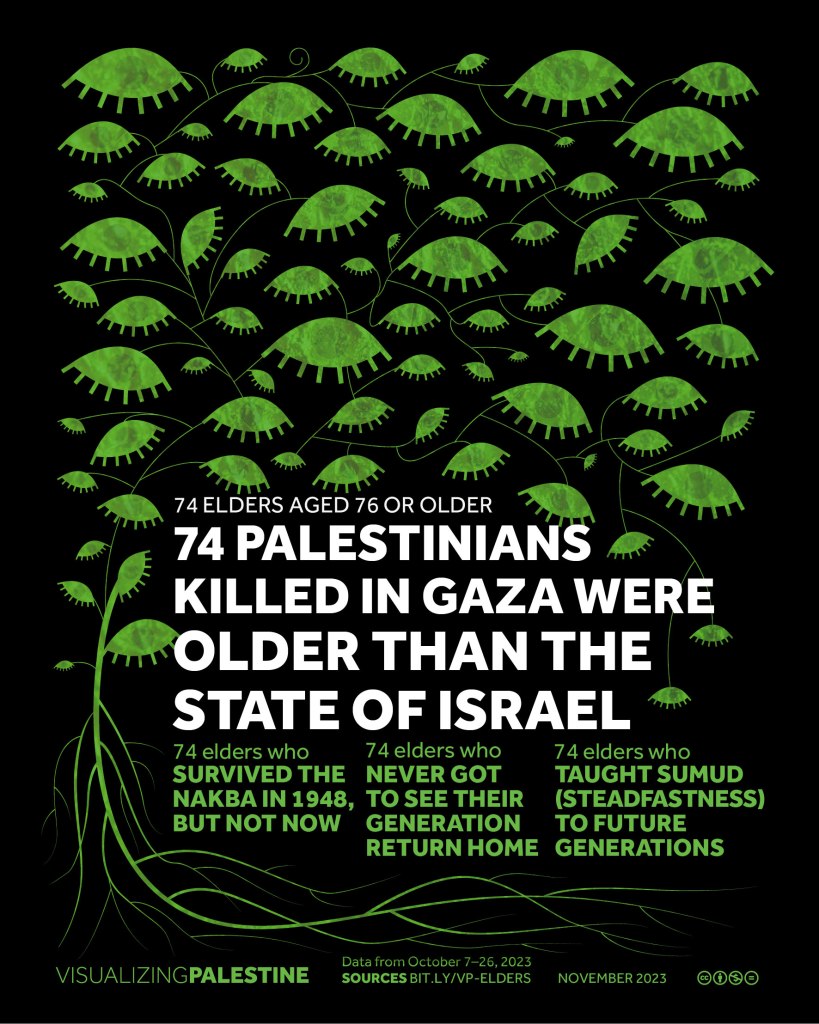
Israeli Occupation of the West Bank and Gaza Strip
The conflict between Israel and the Arab states resumed in 1967 with the Six-Day War. During this war, Israel invaded the remaining Palestinian territories in the new nation – the Gaza Strip and the West Bank – as well as East Jerusalem, and the Golan Heights.
(Israel also captured the Sinai Peninsula in Egypt, though it was returned to the country in 1979 following the peace agreement known as the Camp David Accords. The agreement upheld the idea of ‘land for peace’ and further built upon the idea of a two-state solution.)
This war brought about a second exodus of around half a million Palestinians.
UN SecCo – Resolution 242 and 338
On 22 November 1967, the United Nations Security Council proposed Resolution 242 – outlining the principles for a justified and lasting peace for both states, including the withdrawal of Israeli troops from occupied territories and the termination of all claims/states of belligerency (aggressive or warlike behaviour).
Almost six years later on 22 October 1973, the Security Council proposed another resolution which called for peace negotiations between all parties, among other things. The following year, the UN General Assembly further supported the sacrosanct (unchallengeable) rights of the Palestinian people to self-determination, national independence, sovereignty, and ultimately the right to return to their homeland.
In 1975, the GA established the Committee on the Exercise of the Inalienable Rights of the Palestinian People in an attempt to uphold this, appointing the Palestinian Liberation the status of observer (a privilege granted by the organisation to non-members to allow them an ability to participate in the organisation’s activities) in the Assembly and UN conferences.
1977-1990: Israel invasion of Lebanon, ICQP, and the first Intifada
In June 1982, Israel invaded Lebanon in the hopes of eliminating the Palestinian Liberation Organisation. Almost immediately, a ceasefire was arranged. Troops from the PLO were withdrawn from Lebanon’s capital, Beirut, and transferred to neighbouring Arab countries. However, despite the guarantees of safety for the Palestinian refugees left behind, Israel conducted a large-scale massacre in the camps of Sabra and Shatila, in the centre of Beirut.
The following year, the ICQP (International Conference on the Question of Palestine) laid out issues facing Palestinians, including:
- The need to oppose Israeli settlements
- The status of Jeruslaem as an important holy site for Christians, Muslims and Jews
- The right of all states within the region to exist (within secure and internationally recognised boundaries).
- Guaranteed protection of the rights of Palestinian people.
Alongside this, the right to return to their homeland was also a crucial issue as the majority of Palestinian descendants were made refugees during the mass exodus.
Over the coming years, there would be mass uprisings against the Israeli occupation since it began in the Occupied Palestinian Territory (the Intifada), the first in 1987. Tactics used by the Israeli forces resulted in a drastic amount of casualties and heavy loss of life among Palestinian civilians.
1990: A road to peace?
In 1991, a peace conference was held in Madrid, Spain, to achieve peace between Israel and the Arab states, and, Israel and the Palestinians. The negotiations at this conference were to focus on issues such as the environment, arms control, refugees, water, and economy throughout the region. Further discussions accrued in the mutual recognition of the government of Israel and the PLO, with the signing of the Declaration of Principles on Interim Self-Government Arrangements taking place in 1993.
Subsequent implementation of agreements led to the partial withdrawal of Israeli troops, elections to the Palestinian Council and the Presidency of the Palestinian Authority, and the partial release of prisoners, as well as the establishment of a functioning administration in areas that were self-governed by Palestine.
The Separation Wall
In September 2000, following the visit of Prime Minister Ariel Sharon to Jerusalem, Israel began the construction of a separation wall in the West Bank known as the ‘Israeli West Bank Barrier’ (like that of the one constructed in Berlin during the Cold War). It spanned a total length of 708 kilometres (440 miles) and separated nearly 25,000 Palestinian people from the rest of their territory, and was completed at the end of 2006.
It’s aim? To annex Palestinian land under the false pretence of ‘security’ during the second intifada. The Israeli government cited that there had been a decreased number of suicide bombings from the West Bank between 2000 and 2003 (with the completion of the first continuous segment), and between August 2003 and the end of 2006 (with the completion of the entire wall), thus reinforcing the idea of its efficacy.
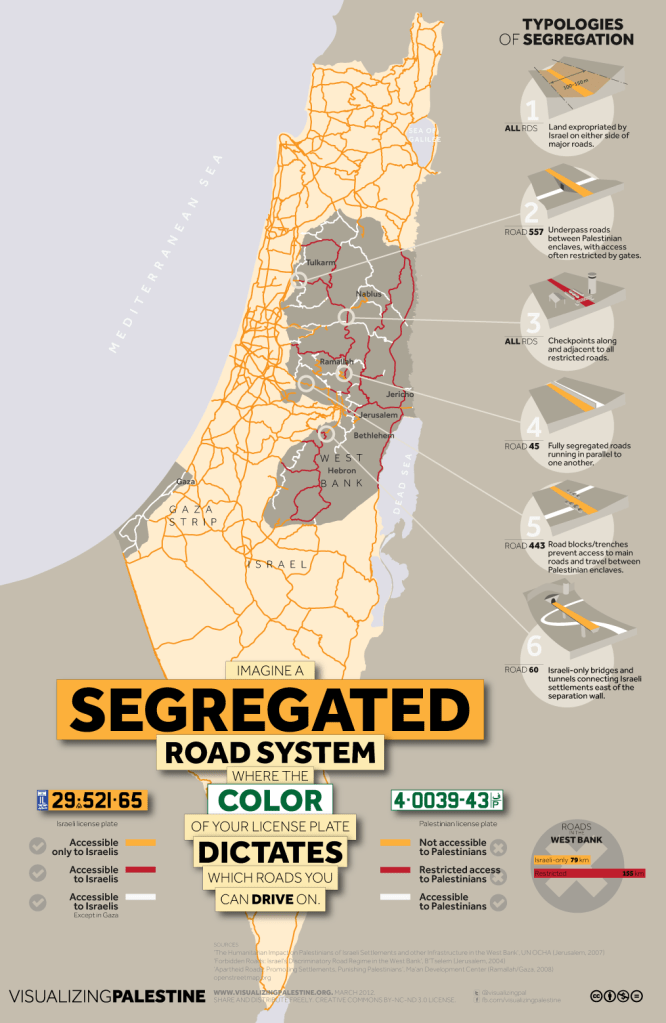
However, in 2004, the International Court of Justice ruled the barrier to be illegal, violating international law – however, the wall still stands today as a clear divider and representation of Israel’s apartheid system.
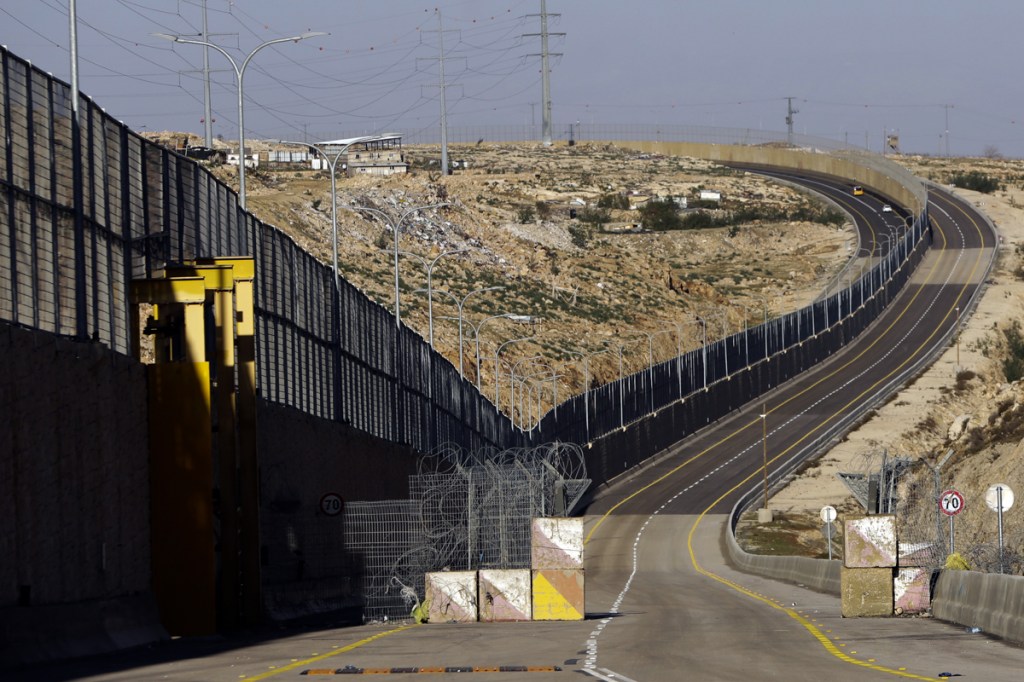
A newly opened segregated West Bank highway is seen near Jerusalem Thursday, Jen. 10, 2019. Israel has opened a controversial new West Bank highway on Thursday that features a large concrete wall segregating Israeli and Palestinian traffic. Critics have branded the road an “apartheid” highway, saying it is part of a planned segregated road system that would benefit Israelis exclusively. (AP Photo/Mahmoud Illean) 


Road Map to Present Day
In 2003, the Quartet (USA, European Union, Russia, and the United Nations) released a ‘Road Map’ to a two-state solution for Israel and Palestine. An unofficial Geneva peace consensus was publicised by notable Israelis and Palestinians. Two years later, Israel withdrew its settlers and troops from the occupied regions of Gaza, meanwhile still maintaining control over its borders, coastal areas, and airspace.
In 2006, following Palestinian legislative elections, the Quarter prepared support for the Palestinian Authority, on the understanding of its commitments to nonviolence, the recognition of Israel, and other agreements accepted throughout the region over the previous 50 years.
However in 2007, following an armed takeover of Gaza by Hamas, an Islamic Militant Group, Israel imposed a blockade (a means of sealing off an area to prevent goods, aid, or people from entering or leaving), again similar to that witnessed during the Cold War in Berlin.

Increasing rocket fire and air strikes in the latter half of 2008 resulted in Israeli troops conducting a ground operation in Gaza. The following year, the UN General Assembly investigated violations of international law, publishing the ‘Goldstone Report’ (authored by South African jurist Richard Goldstone, who was appointed to lead the mission) in September 2009. The report accused both the IDF (Israel Defence Forces) and Hamas of war crimes, as well as crimes against humanity, and recommended that both sides investigate their conduct within the conflict. The Israeli government rejected the report, claiming it was prejudiced and full of inconsistencies/errors, and denied the allegations that it had a policy of deliberately targeting civilians.
In November 2012, another cycle of violence between Israel and Gaza resulted in an Egyptian-brokered ceasefire. Another round of negotiations was started in 2013 but was suspended by Israel in April 2014 after the announcement of a Palestinian national consensus Government. As a result, in 2012, Palestine was granted non-member observer State status in the United Nations, and in 2014 the GA announced an International Year of Solidarity with the Palestinian people. But, yet another cycle of violence took place between July and August 2014.
In 2017, the US Administration announced Jerusalem as the official capital of Israel, which subsequently resulted in all governmental operations moving to the capital.
In 2020, the UN GA requested the International Court of Justice to provide an Advisory Opinion on the legality of the prolonged Israeli occupation that began in 1967, and the implications for the Member States.
Early 2023 brought about another round of fighting between Israel and Hamas, and on 15 May 2023, following a request by the GA, the United Nations commemorated the 75th anniversary of the Nakba for the first time.
October 2023
If you’ve read this far, you might be beginning to wonder why the war that began on 7 October 2023 is different from the rest. The truth is, fundamentally, it’s not. But, it feels like it. Perhaps because it is being publicised more with social media, or perhaps because after 75 years it feels like something should have changed and progress should have been made. Or maybe, it’s because for the first time, the world is finally seeing the truth about Israel, the tyrannical leadership of its Prime Minister, and the way Palestinian people are being treated in the small strips of land they call their home.
Benjamin Netanyahu has been Prime Minister of Israel for the majority of the two decades preceding the war – from 1996 to 1999, and again from 2009-present, and has been criticized by people around the world as championing Hamas and their policy. His motivations for doing this, they say, are as a way of sabotaging a two-state solution by confining the PLO to the West Bank and weakening its effectiveness to demonstrate to Israel’s citizens and the Western world that Israel does not need, nor have, a partner for peace. This criticism has been upheld by several Israeli officials, including former PM Ehud Barak, and the former head of Shin Bet Yuval Diskin.
In February 2023, Netanyahu authorised the legalization of nine settler outposts in the West Bank. (An outpost is an unauthorized or illegal Israeli settlement constructed without the required authorization of the government.)
The following month, in March 2023, his government overturned a 2005 law whereby four Israeli outposts – Homesh, Sa-Nur, Ganim, and Kadim – were dismantled as part of the Israeli force’s withdrawal from Gaza in 2005.
Three months later, in June 2023, his coalition government changed the 27-year procedure for approving the construction of settlements, shortening it and allowing for the Finance Minister to approve one of the stages. Since then, 13,000 housing units in settlements have been constructed – almost triple the entire amount constructed in 2022.
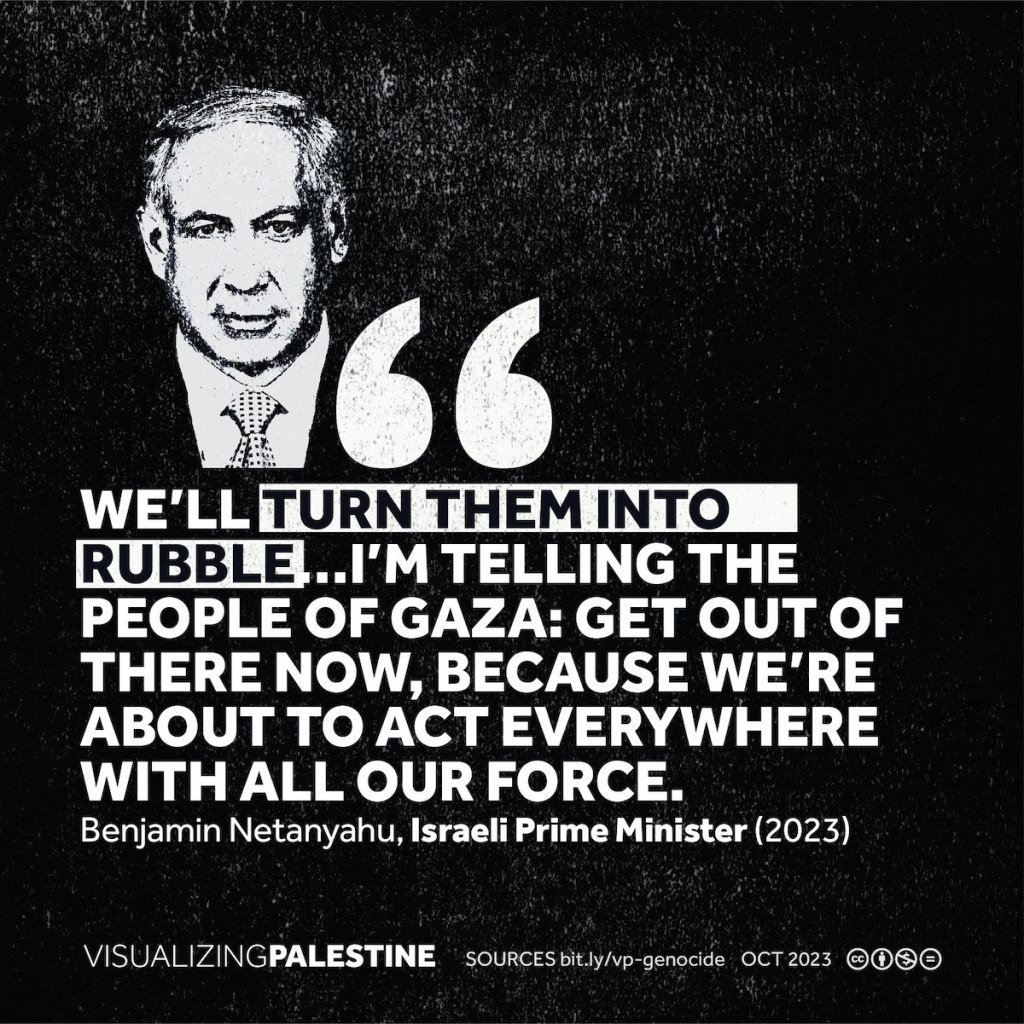
In October 2023, after Hamas launched a major ‘surprise’ attack, Netanyahu declared war against Hamas. He spoke about turning ‘all the places where Hamas is organized and hiding’ into cities of ruins and maintained the stance that Gaza is a ‘city of evil’, urging all of its residents to evacuate immediately.
Of course, this doesn’t sound like a big deal because everybody gets evacuated during war for their safety, don’t they?
And yet, for the third time in 75 years, Palestinians are being forced out of their homeland. And they are not being protected.
More than 26,000 innocent Palestinians have been killed in the war so far – most of them women and children… and yet, Netanyahu has described the civilian casualties as ‘collateral damage.’ On 13th October, the IDF called for all 1 million residents of Gaza City to evacuate their homes and move south for their protection, as the IDF prepared for an extensive ground operation against Hamas fighters.
On October 17th, Israeli air raids killed at least 71 people and injured at least 50 others in Gaza. On the same day, hundreds of people were killed in an explosion in a hospital in the middle of Gaza, which was being used to shelter thousands of residents displaced from their homes. This cycle continues day after day, week after week. Palestinians are being told to evacuate. Israel bombing safe places where Palestinians are sheltering, under the pretence that it has ‘Hamas militants’ hiding inside.
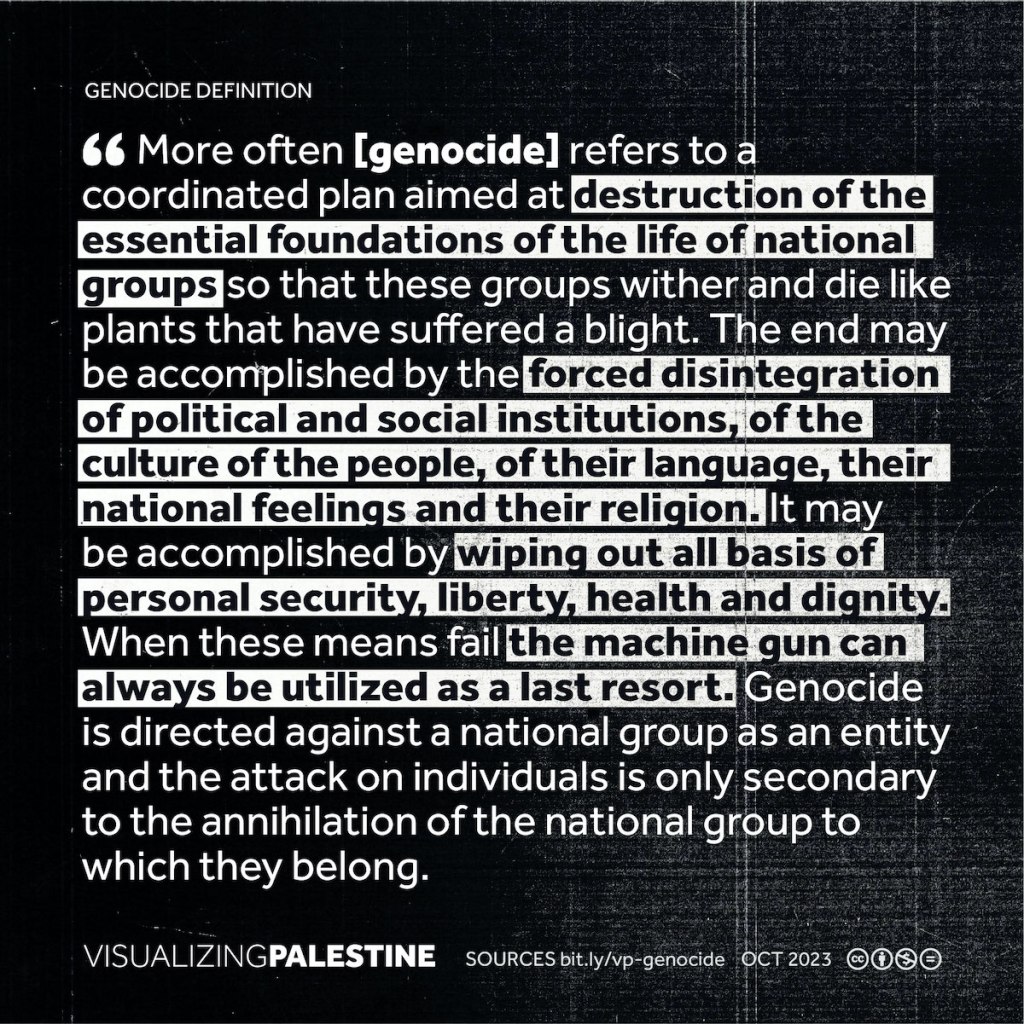
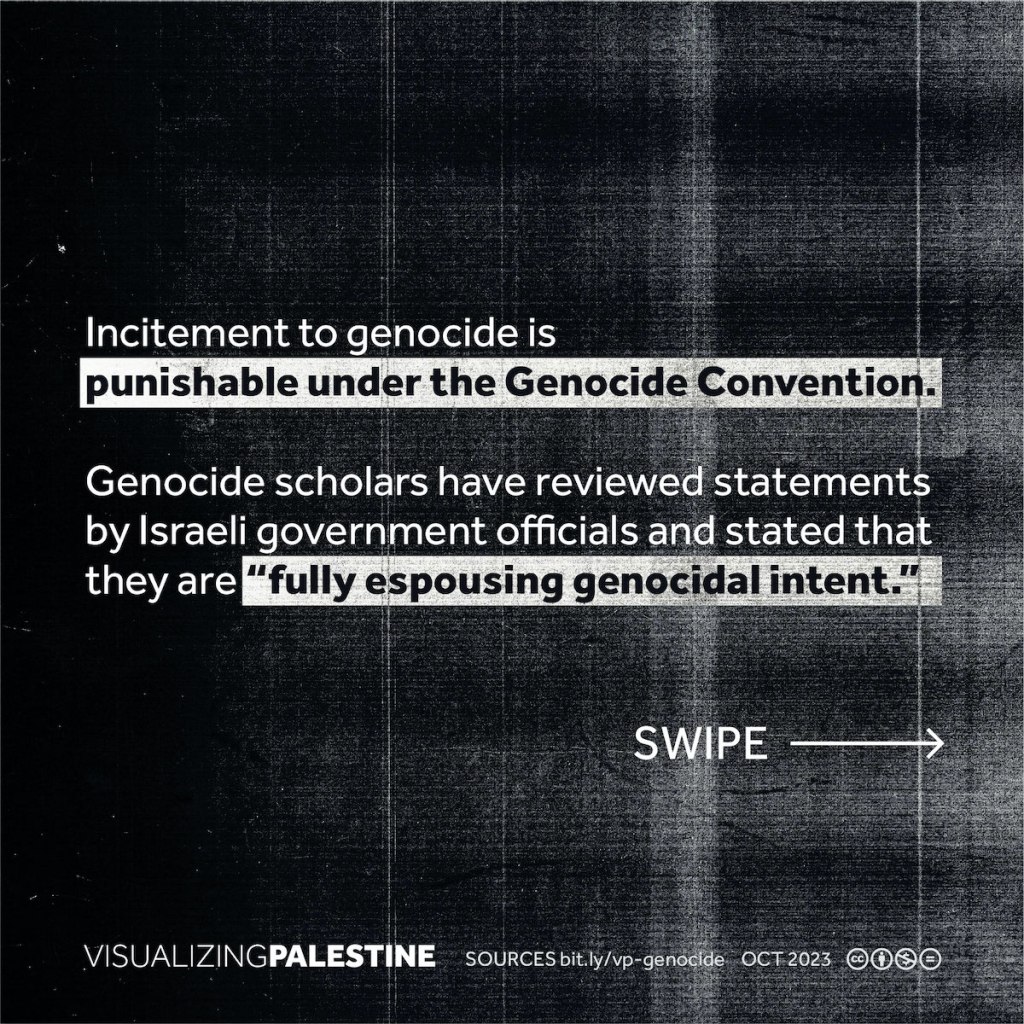
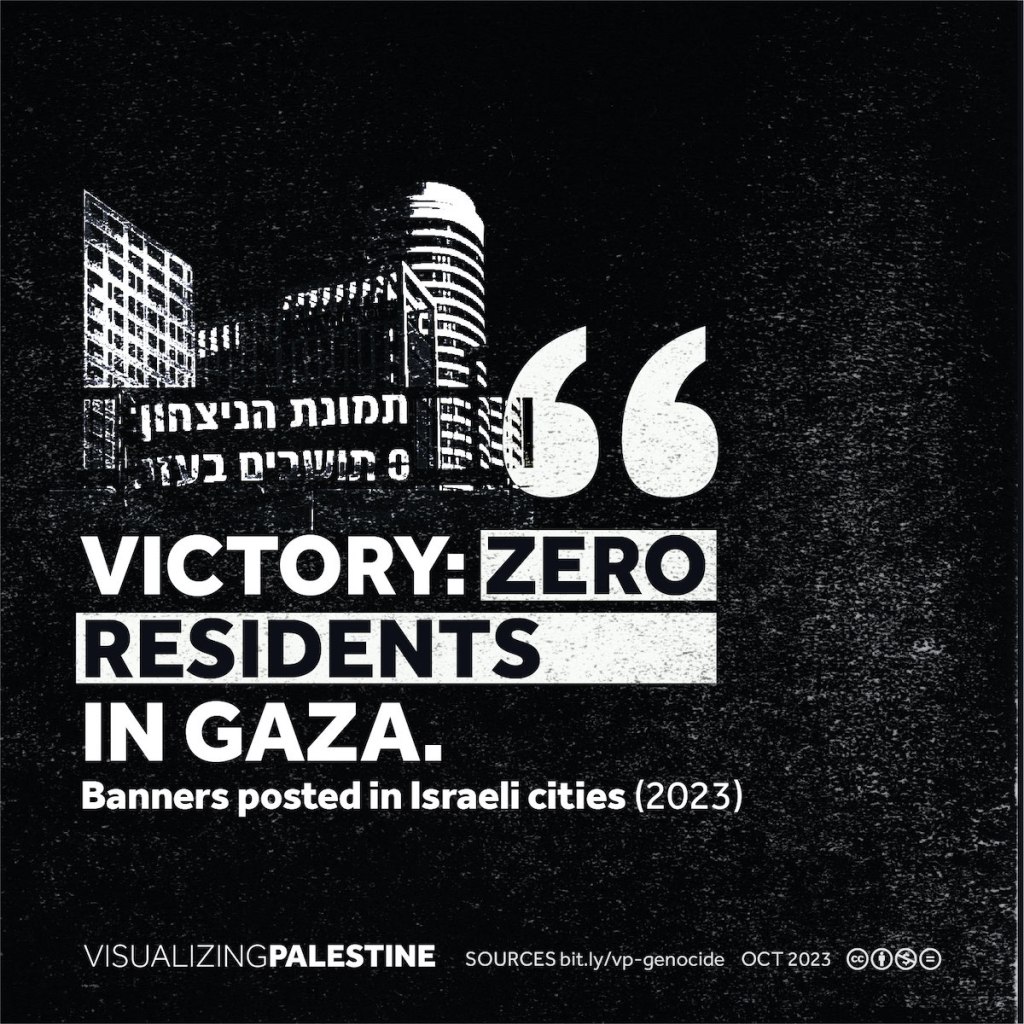
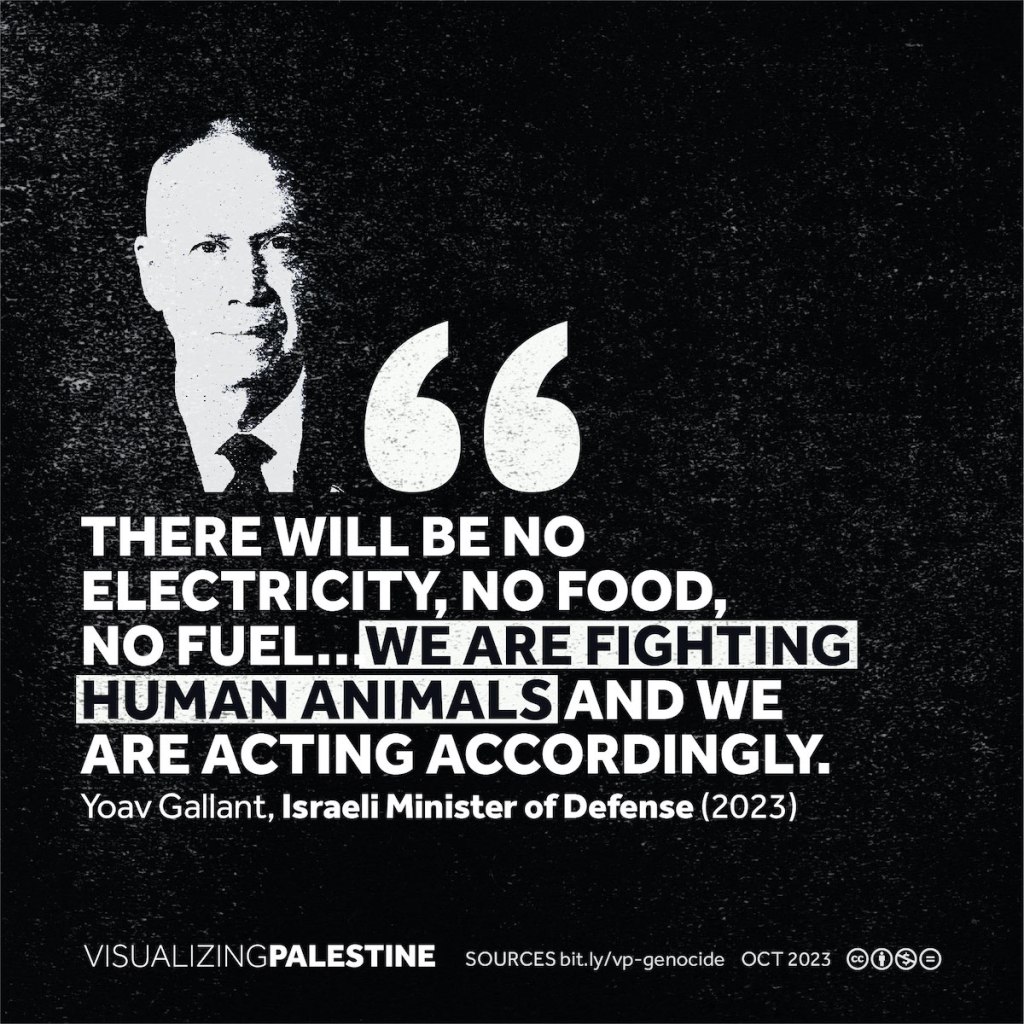
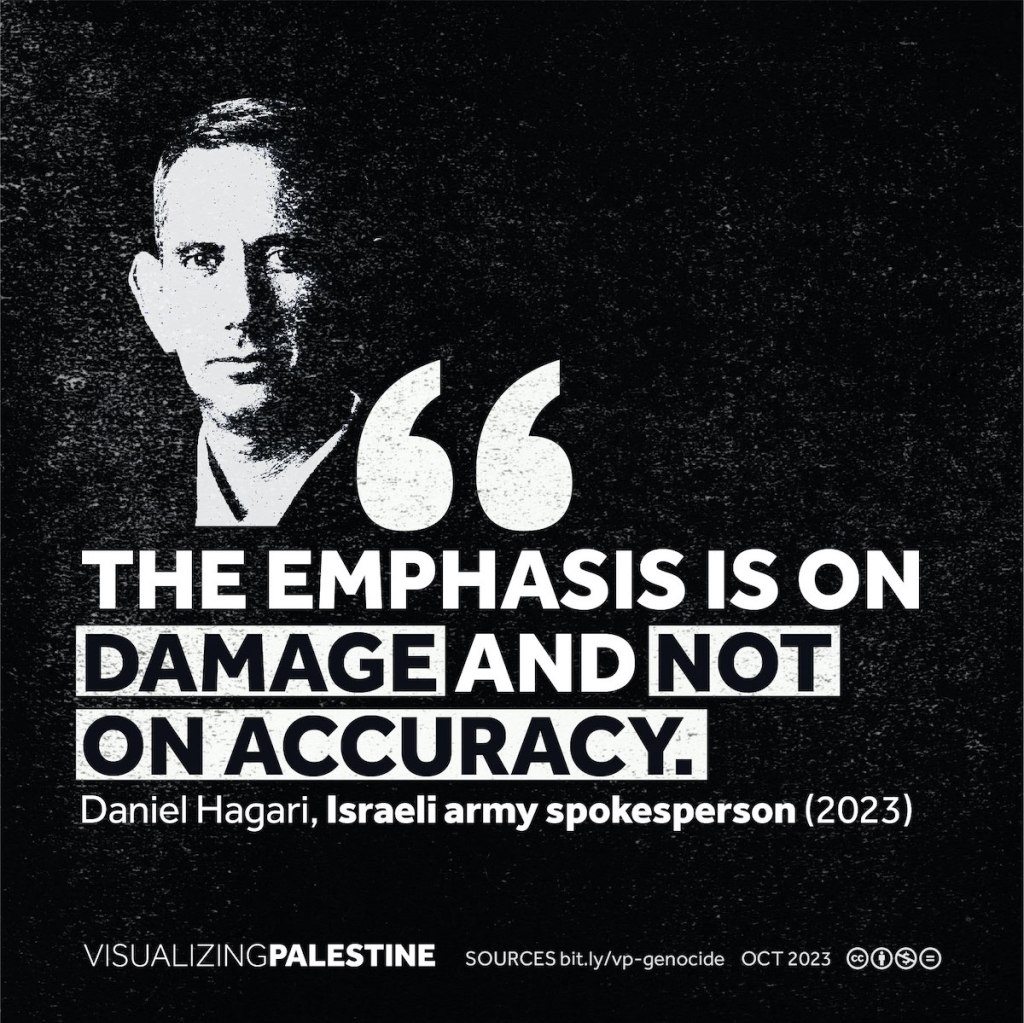
Netanyahu has stated that he will not stop until there is total victory over Hamas – vowing that fighting will continue even if a temporary ceasefire is reached. But, this is no longer a war against Hamas. This is genocide.


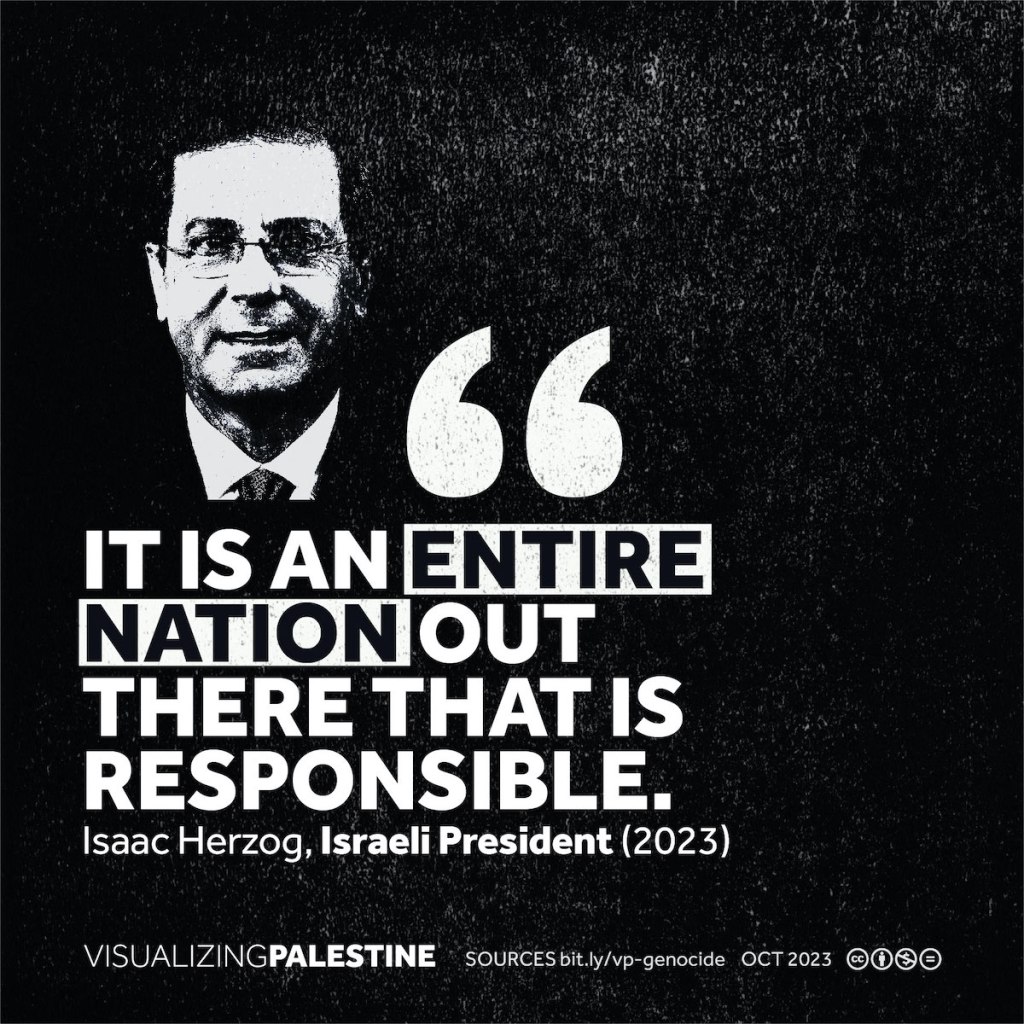
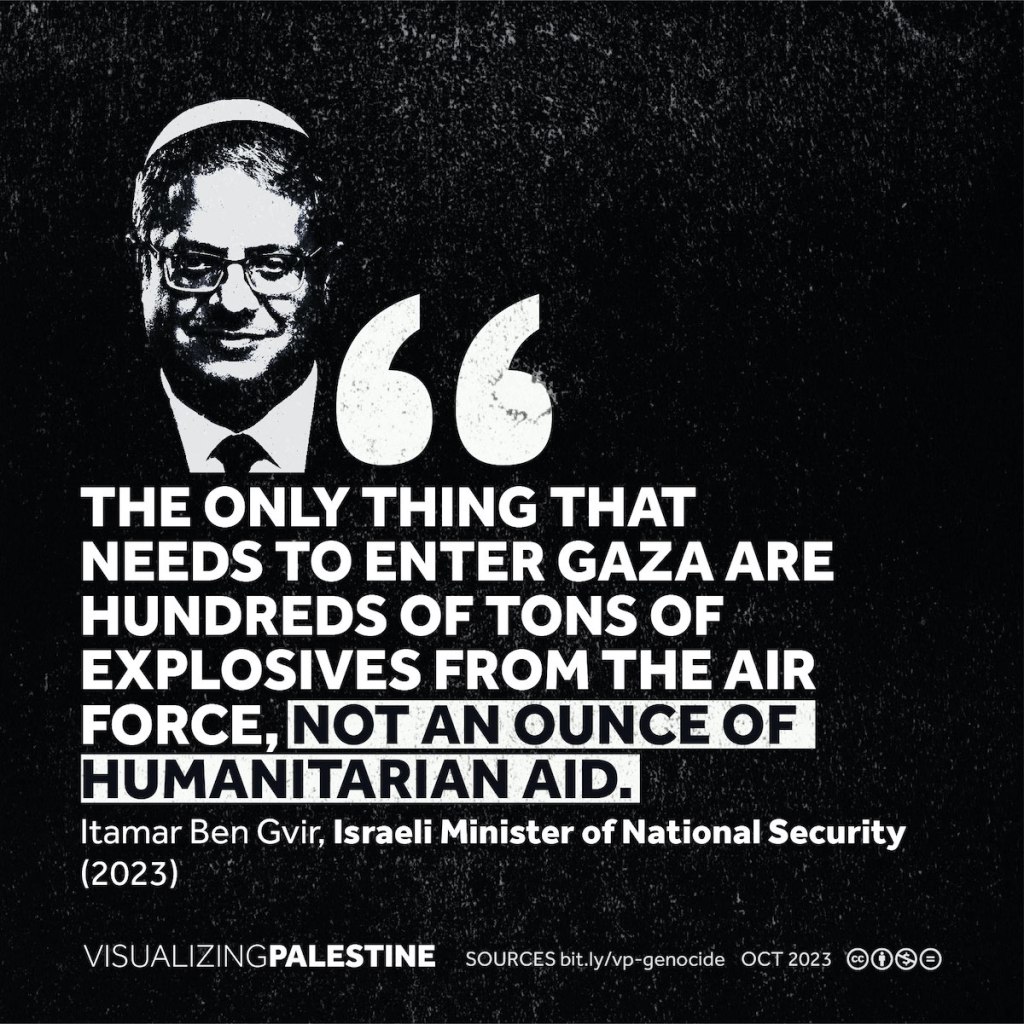
Of course, I realise there is nothing we can do as innocent civilians to immediately change the scenario. That is in the hands of our politicians and world leaders.
But, as I said at the beginning of this post, there is a quote in the movie National Treasure, that has always stuck out to me: ‘Those who have the ability to take action, have the responsibility to take action.’
We have the ability to use our voices – to put pressure on our governments with petitions and peaceful protests to affect change. Some of us have the ability to donate to causes or fundraise. Others have the ability to use their platforms to spread awareness and keep the conversation going. Ultimately, that is what I have aimed to do here. We have a responsibility to continue to speak on behalf of those who cannot. And we have to persevere until there is peace and justice.
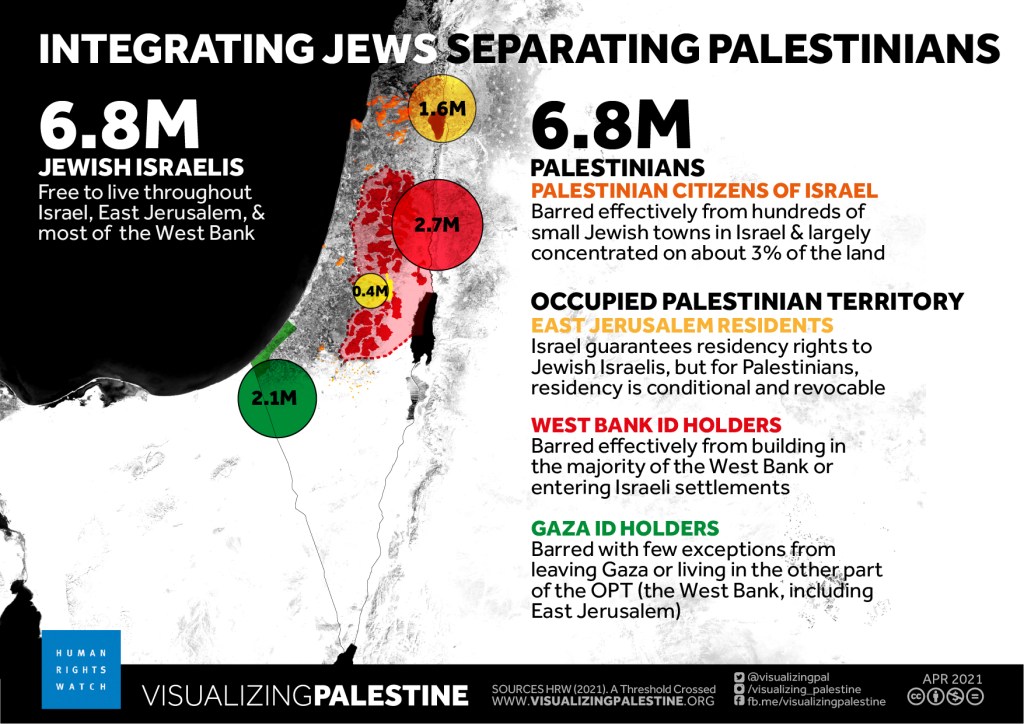
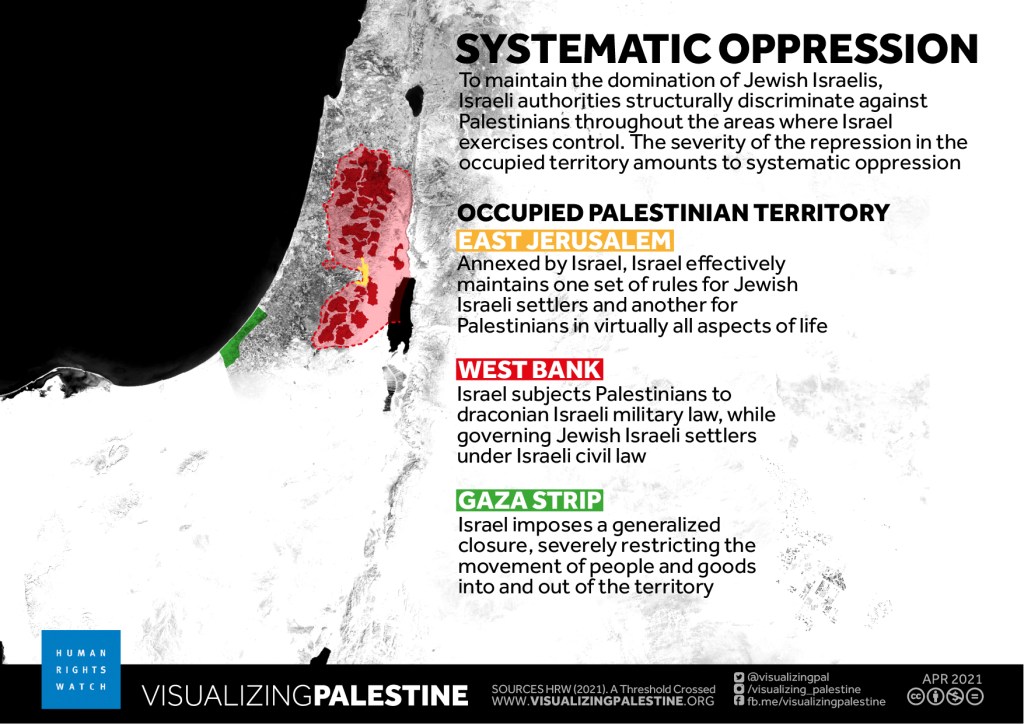
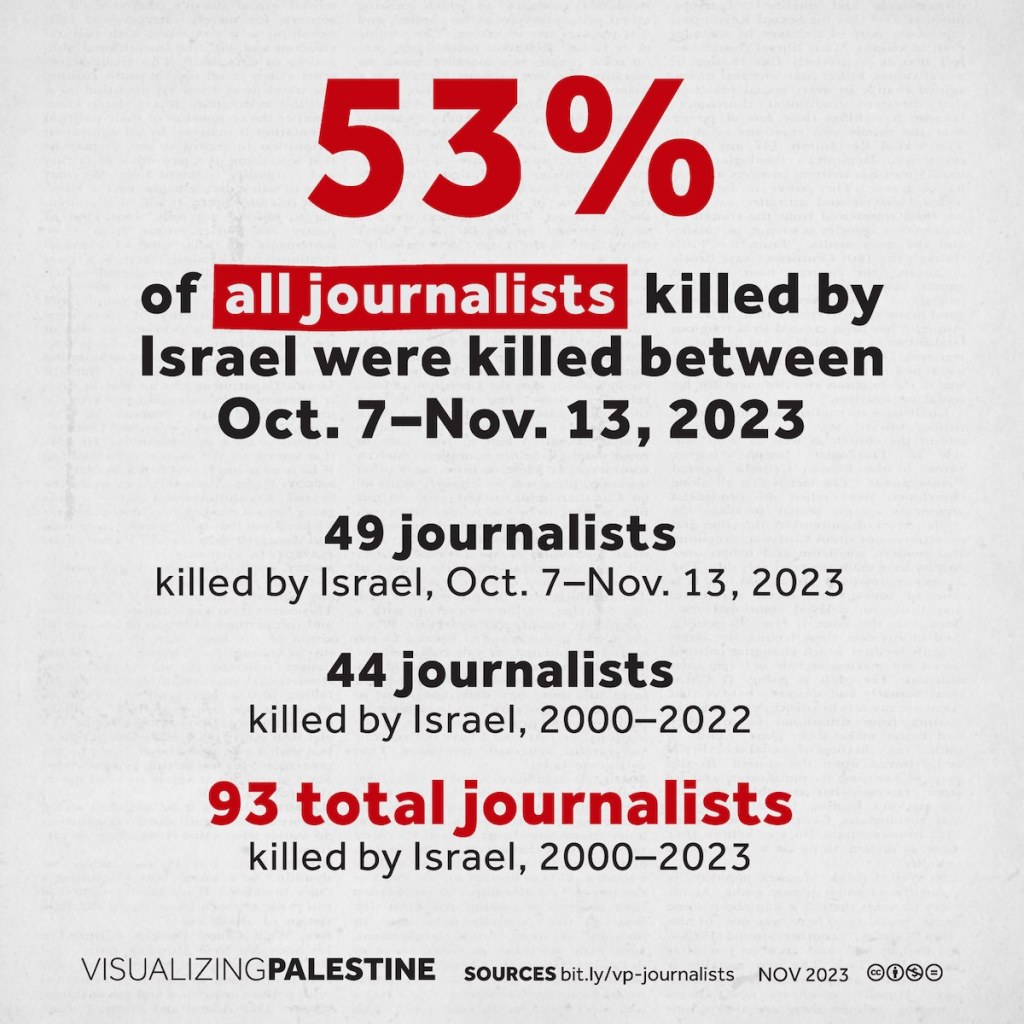
Infographics
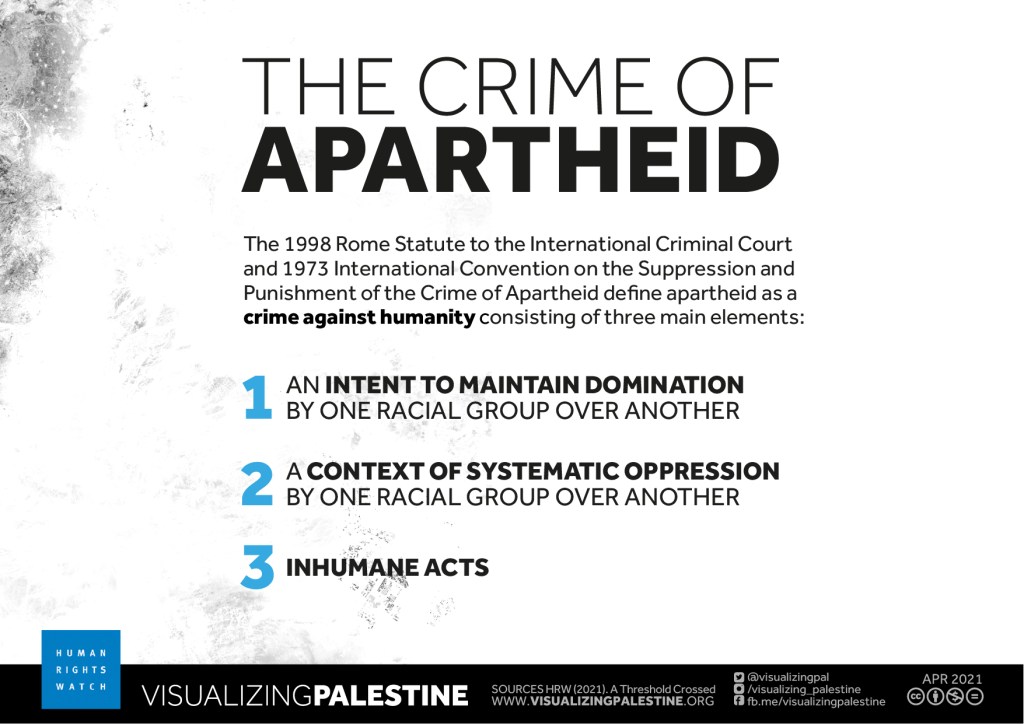
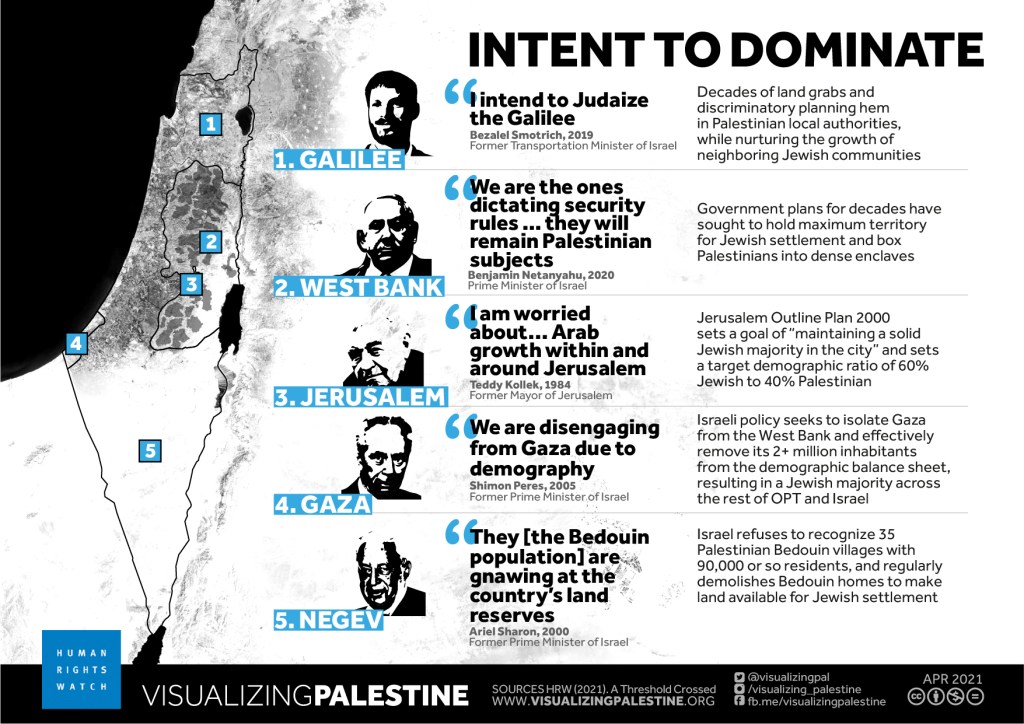
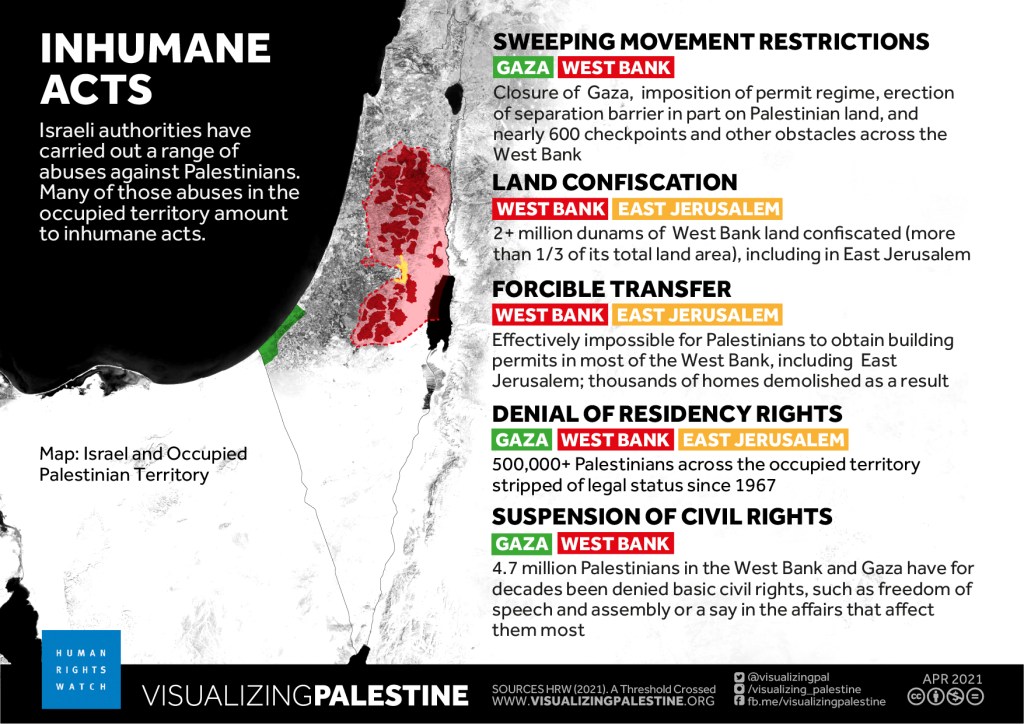
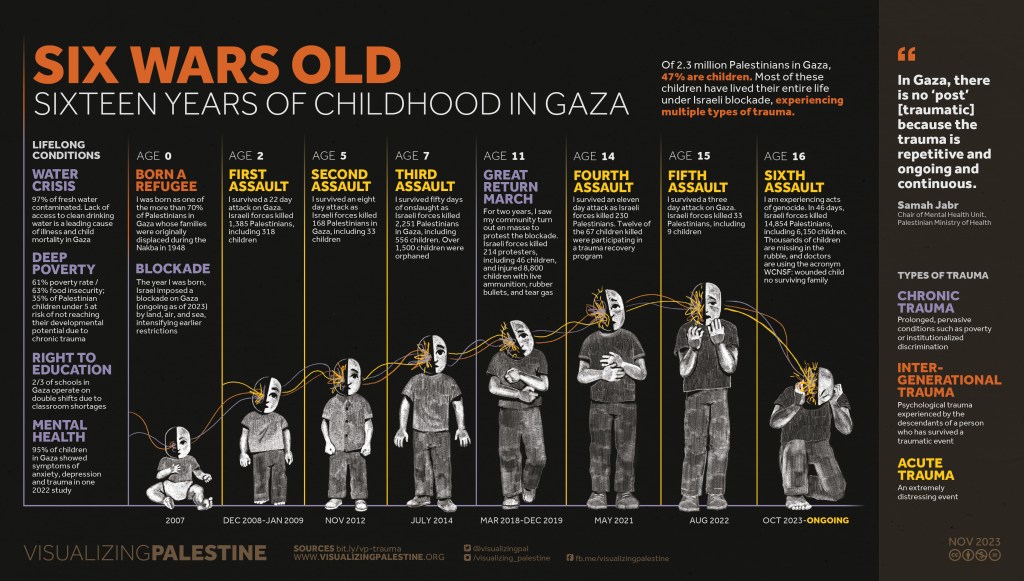
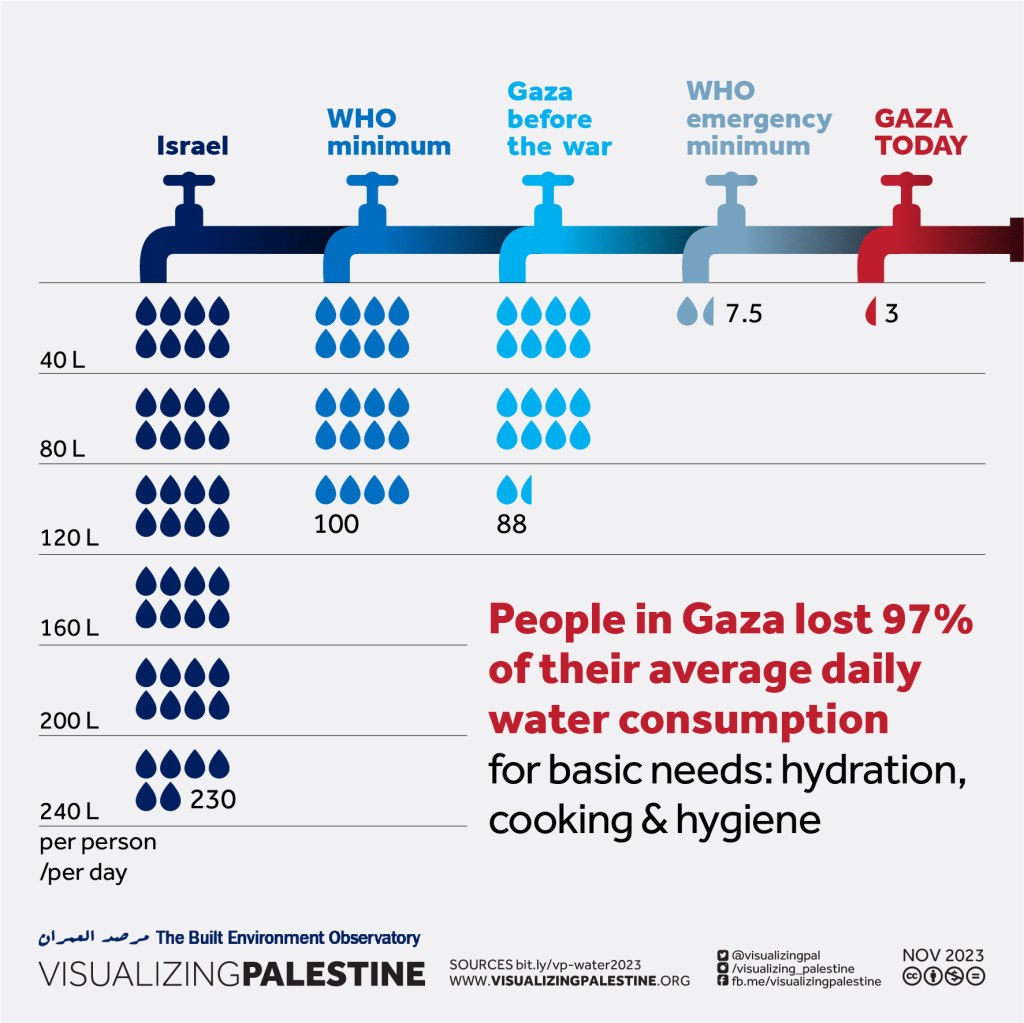
I realise there is a lot of information in this post – and unfortunately, this is not even the tip of the iceberg. If I were to write about every small detail this post would take you a year to read. I also understand it can be hard to visualise the sheer complexity and magnitude of all of the stats and statistics. So, when I came across a site called Visualising Palestine, a site that creates infographics on this particular topic, I thought it would be useful to share them here with you (with their permission).


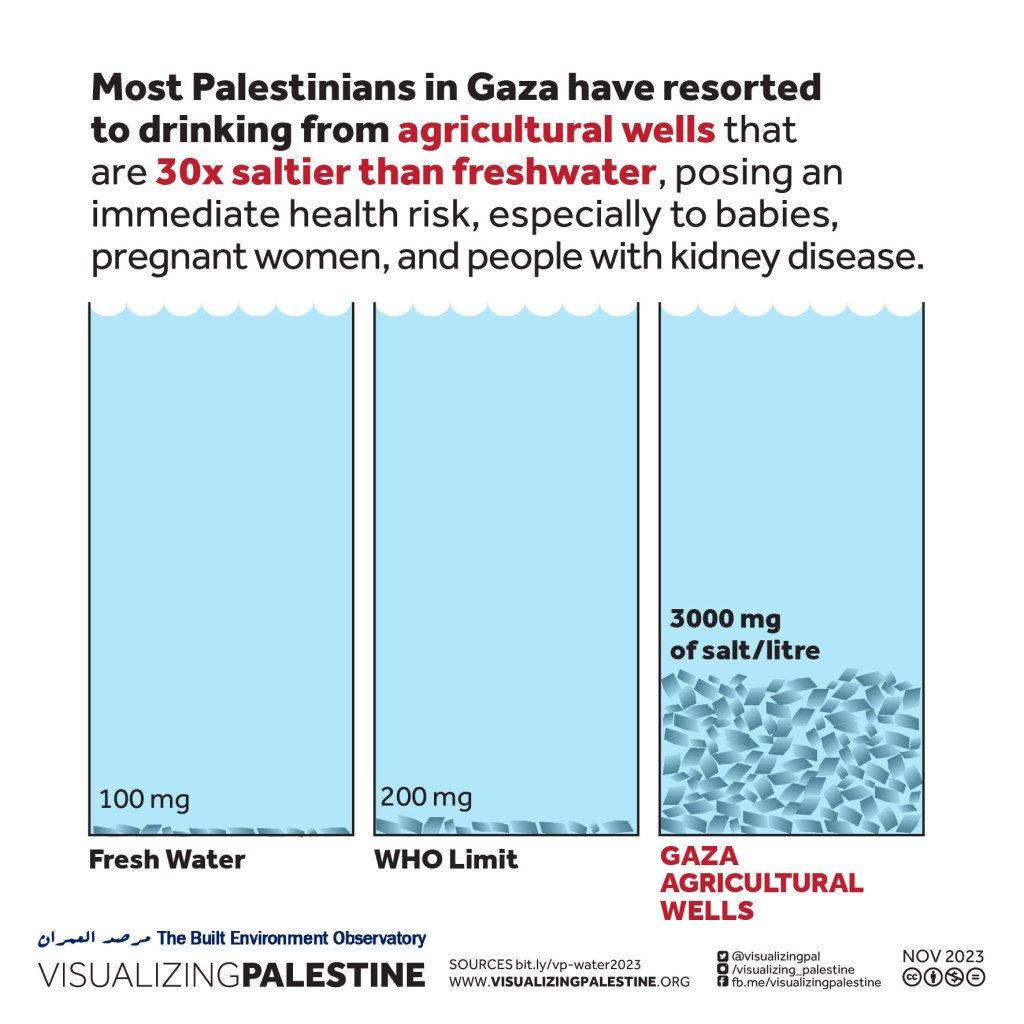
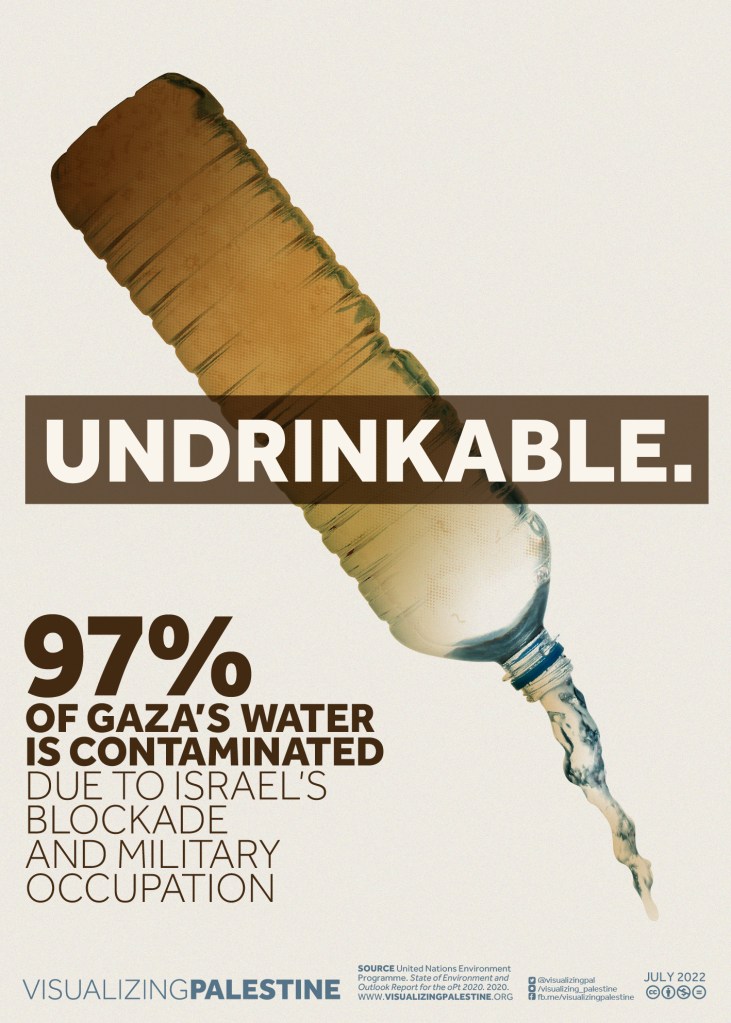


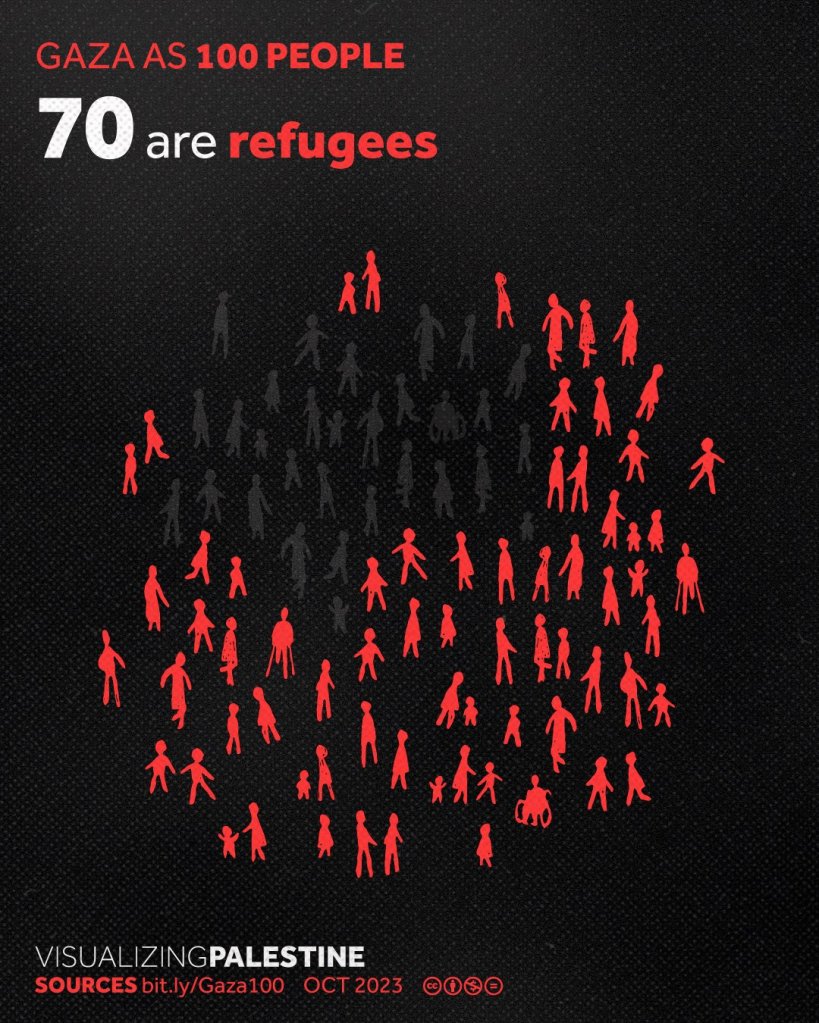


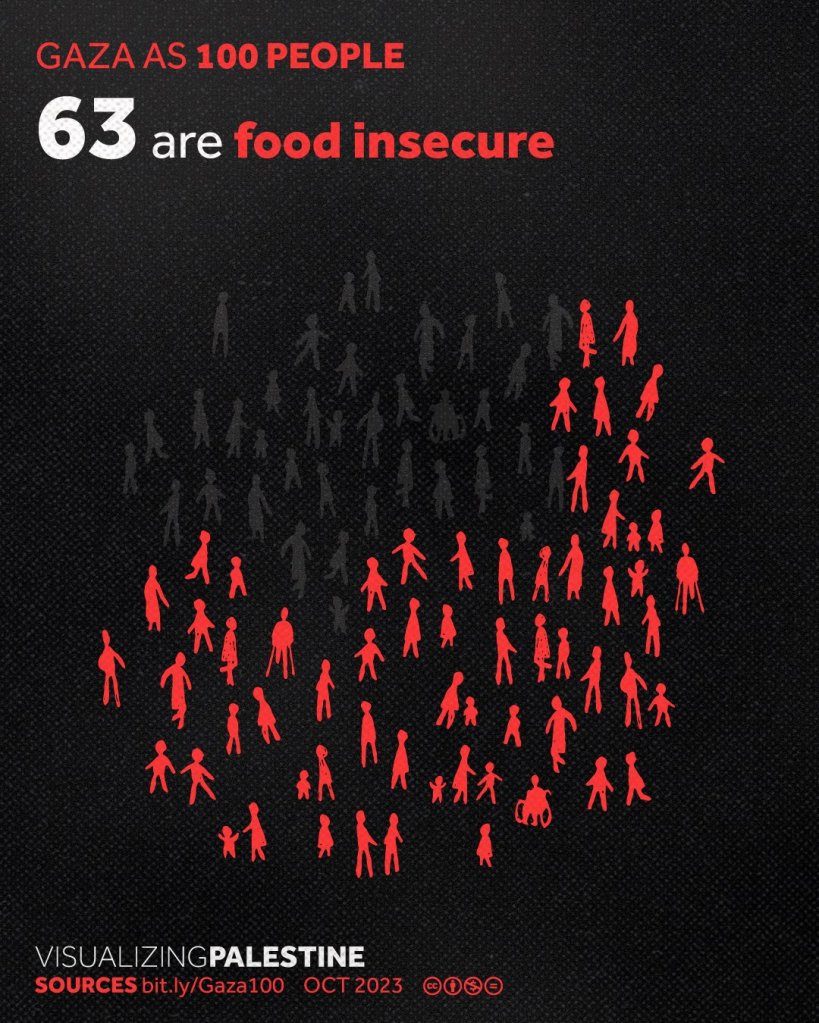
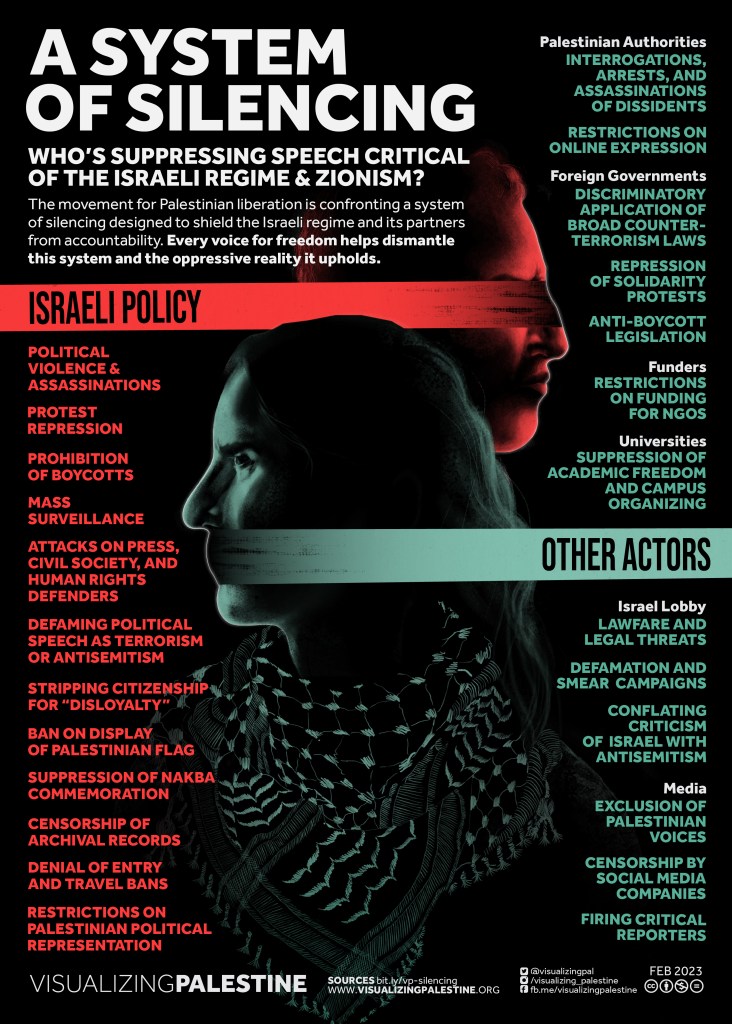

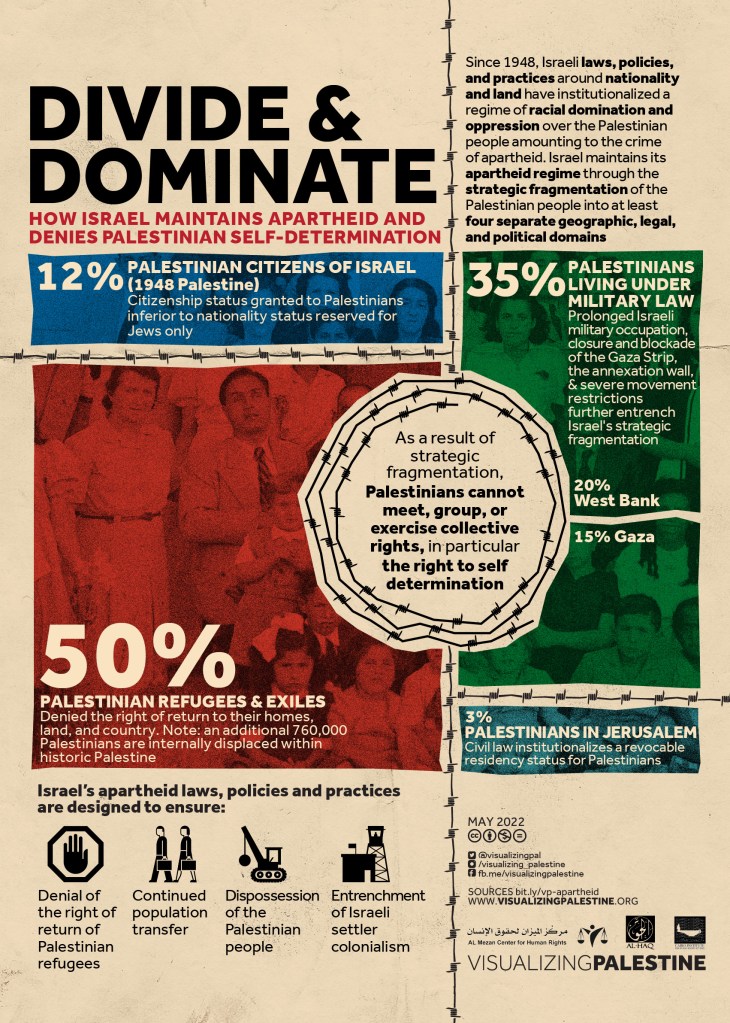
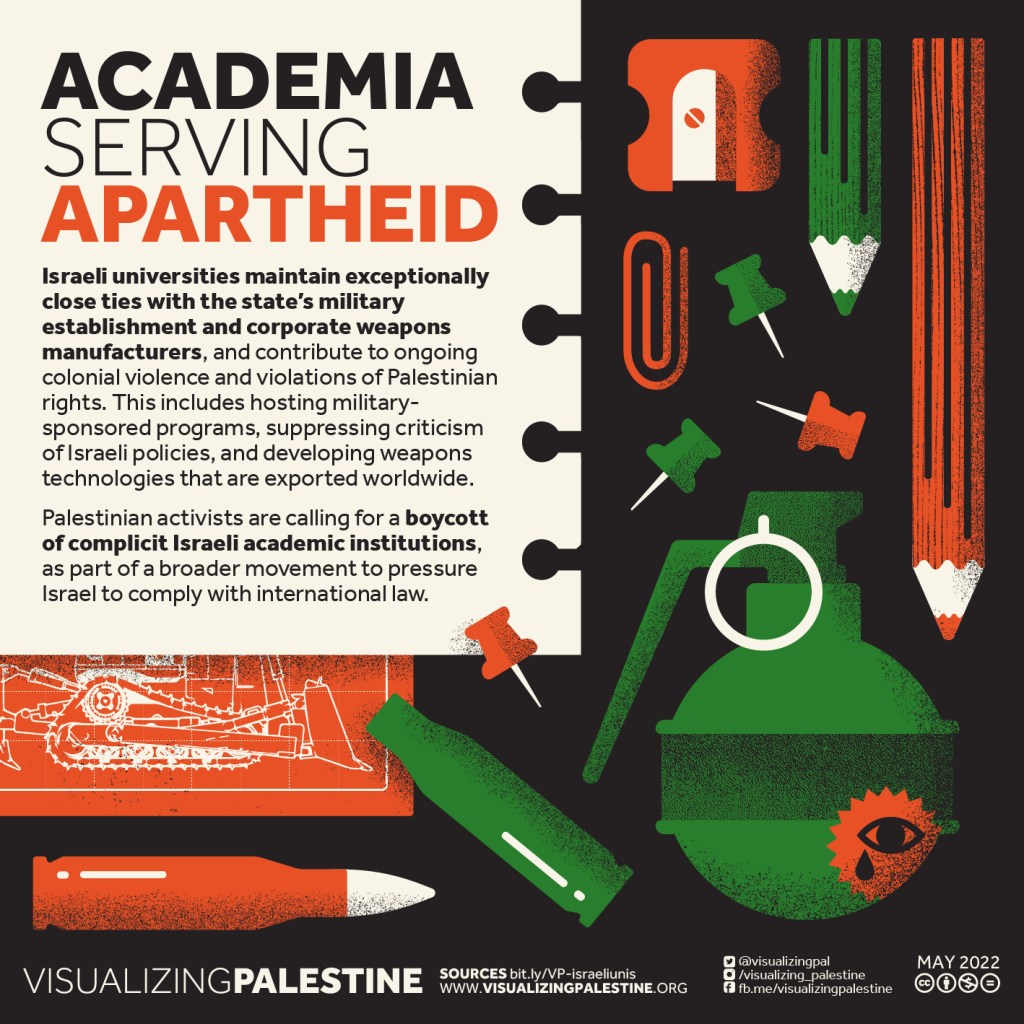

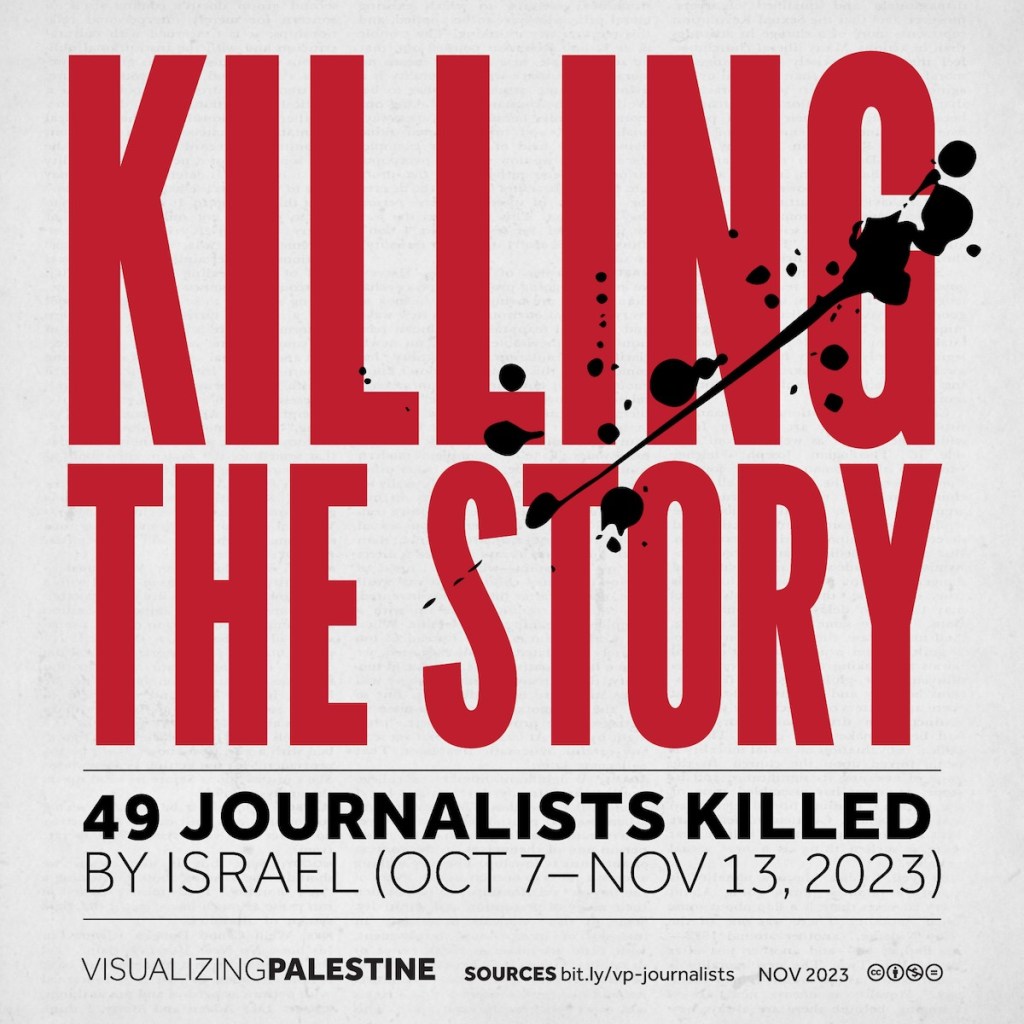

Books:
A list of books – both fiction and non fiction – for extra reading. I will continue to update this list as and when I find more. I have included Amazon (or other) links to the books, but obviously most of these can probably be found in bookstores or on other websites.
The Hunded Years War on Palestine by Rashid Khalidi
Palestine: A Four Thousand Year History by Nur Masalha
Pay No Heed to the Rockets by Marcello Di Cintio
Erasing Palestine by Rebecca Ruth Gould
They Called Me A Lioness by Ahmend Tamimi and Dena Takruri
Unsilencing Gaza by Sara Roy
On Palestine by Noam Chomsky and Ilan Pappe
In Search of Fatima by Ghada Karmi
Greater Than The Sum of our Parts: Feminism, Inter/Nationalism, and Palestine by Nada Elia
One State by Ghada Karmi
The Gun and The Olive Branch: The Roots of Violence in the Middle East by David Hirst
A History of Modern Palestine by Ilan Pappe
Where The Line is Drawn by Raja Shehadeh
I Saw Ramallah by Mourid Barghouti
My Father Was A Freedom Fighter by Ramzy Baroud
In My Mother’s Footsteps: A Palestinian Refugee Returns Home by Mona Hajar Halaby
Minor Detail by Adania Shibli
My First and Only Love by Sahar Khalifeh
Palestine’s Children: Returning to Haifa and Other Stories by Ghassan Kanafani
Salt Houses by Hala Alyan
The Ethnic Cleansing of Palestine by Ilan Pappe
Fast Times in Palestine by Pamela J Olson
Palestine by Joe Sacco
The Making of the Modern Middle East by Jeremy Bowen
Ten Myths About Israel by Ilan Pappe
Enemies and Neighbours: Arabs and Jews in Palestine and Israel, 1917-2017 by Ian Black
Palestine: A Socialist Introduction by Sumaya Awad
My Name is Palestine by Nadine Foty
Except for Palestine: The Limits of Progressive Politics by Marc Lamont Hill
Israeli Apartheid by Ben White
Palestinians in Israel: Segregation, Discrimination and Democracy by Ben White
Cracks in the Wall: Beyond Apartheid in Palestine/Israel by Ben White
Voices of the Nakba: A Living History of Palestine by Diana Allan and Rosemary Sayigh
Method and Madness: The Hidden Story of Israel’s Assaults on Gaza by Gary Dana, Norman G Finkelstein, et al.
The Two-State Delusion by Padraig O’Malley
The Palestine-Israel Conflict: A Beginner’s Guide by Dan Cohn-Sherbok
Palestinians and Israelis: A Short History of Conflict by Michael Scott-Baumann
Homeland: My Father Dreams of Palestine by Hannah Moushabeck and Reem Madooh
A Day in the Life of Abed Salama: A Palestine Story by Nathan Thrall, Peter Ganim, et al.
The History of Palestine: Exploring the Past and Present of a Contested Land by Matthew Rivers
The Biggest Prison on Earth: A History of the Occupied Territories by Ilan Papper, Paul Boehmer, et al.
Olive Harvest in Palestine by Wafi Shami and Shaima Farouki
We Could Have Been Friends, My Father and I: A Palestinian Memoir by Raja Shehadeh, Peter Ganim, et al.
Decolonizing Israel, Liberating Palestine: Zionism, Settler Colonialism, and the Case for One Democratic State by Jeff Halper
Gaza in Crisis: Reflections on Israel’s War Against the Palestinians by Ilan Pappe and Noam Chomsky
Policy of Deceit: Britain and Palestine, 1914-1939 by Peter Shambrook
Palestine: The Land, The People, and the Oppression by Sonia Anisa
Ways to Donate:
United Nations Relief and Works Agency
British Red Cross – Israel and Occupied Palestinian Territory Appeal
Gaza Emergency Appeal by HumanAppeal
Gaza Emergency Appeal by Save the Children
Ways to Help
Jewish Voice for Peace – largest progressive Jewish anti-zionist organisation. Organising a grassroots, multi-racial, cross-class, intergenerational movement of US Jews into solidarity with Palestinian freedom struggle.
Apartheid Free – an intiative launched by AFSC and partners, with over 170 groups, communities and organisations pledging themselves to end all support to Israel’s apartheid regime, settler colonialism, and military occupation.
Change Petitions – sign a global petition.
Spead awareness on your social media platforms, using reliable sources (such as Visualising Palestine).
You must be a UK resident to sign the petitions below.
At 10,000 signatures, the government will respond. At 100,000 signatures, the petition will be considered for debate in parliament.
Ones to sign include:
Create a Palestinian Family Visa Scheme for Palestinian people affected by war – https://petition.parliament.uk/petitions/648577
Seek a ceasfire and to end Israeli occupation of the West Bank and Gaza Strip – https://petition.parliament.uk/petitions/648292
Urge the Israel Government to allow fuel, electricity and food into Gaza – https://petition.parliament.uk/petitions/648383
Remain neutral in Israel-Palestine conflict and withdraw support for Israel – https://petition.parliament.uk/petitions/648225
Withdraw support for Israel and support Palestine in Israel-palestine conflict – https://petition.parliament.uk/petitions/648456
Call for an immediate ceasfire in Israel and Gaza – https://petition.parliament.uk/petitions/649130
A Timeline of the Israel-Hamas Conflict – New York Times
History of the Israeli-Palestine Conflict: A Chronology – Washington Post
Israel-Palestine: A Timeline of the decades long conflict – Evening Standard

“The One With the Goodbye…”
It’s hard to know where to begin. This is not a post I thought I would be writing for many, many years, and yet, here we are.
On Sunday morning, I woke up to the news of Matthew Perry’s passing, and I cried, in a way that I haven’t cried over a celebrity’s death since Cory Monteith. Full-on snot-sobs. I am heartbroken and devastated, to say the least. Days later, and it still feels so surreal to me.
Mourning the passing of a famous person you love is a bizarre thing. You have no physical personal connection with them in the way that you do with your friends and family, and yet, you feel the grief as deeply as if you knew them intimately. It is as raw and as painful as losing a member of your own inner circle. But, it is a testament to the meaningful impact they have had on you through their work.
The first thing you are overwhelmed with is shock. For any death, even if you know it’s coming, it’s still shocking. As humans, we are not innately programmed to think about mortality, and it is sometimes a curse that we are the only sentient species on the planet that are aware of it. I think a lot of us see celebrities as being immortal, but the truth is, they are not. It is the one thing which we all share – the inability to escape our eventual demise. We do not ruminate on it during everyday life otherwise we would find it simply impossible to function. But, when it happens to someone we love and admire, our brain is confronted with reality, and it is startled because it spends the majority of its time shielding us from it. We feel the shock reverberate through our body – sometimes physically, as we end up hiccuping through our sobs, or a tightness in our chest when it feels like our heart is physically aching.
Hearing about Matty’s death shocked me to my core. And yet, there was a part of me that was not surprised. After all, if you read his memoir – Friends, Lovers, and The Big Terrible Thing – he had so many near misses with death that it genuinely made you wonder how it hadn’t happened sooner.
I listened to the audiobook version of his memoir last year and flew through it. It was heartbreaking, funny, and poignant – perhaps three words that best sum up Matthew Perry. For somebody who found so much joy and purpose in trying to make others laugh, he battled some dark, dark demons. He spent decades struggling with an addiction to alcohol and substances, and as a result, his body succumbed to real wear and tear.
In 2019, at the age of 49, he nearly died from a burst colon – the result of his overuse of opioids. He underwent seven hours of emergency surgery, with doctors only giving him a 2 per cent chance of survival. After the surgery, he slipped into a two-week coma and spent a further five months in hospital, as well requiring a colostomy bag for nine months, and another 14 surgeries to repair the damage.
He also shared another of his near-death experiences at a rehab facility in Switzerland, where had been taking hydrocodone to treat his stomach pain before surgery. In the operating room, they had administered Propofol – a common IV medication used for induction and maintenance of general anaesthesia – but the two drugs interacted and caused him to enter five minutes of cardiac arrest. (Note: cardiac arrest is not the same as heart attack which is caused by a blockage to the blood flow. CA simply means the sudden loss of all heart activity.) They managed to resuscitate him, but broke eight ribs in the process, causing him to pull out of his role in the film Don’t Look Up, alongside Meryl Streep.
It is at this point in the book, where he asks you to temporarily pause reading/listening and time five minutes with a stopwatch to appreciate the gravity of how long it actually feels, because while it seems like a short amount of time for us in everyday life, when there is nothing happening – at all – it feels like an eternity.
He also shared that more recently, he was diagnosed was emphysema – a disease that involves damage to the lining of the lungs and the destruction of alveoli – as the result of his decades of smoking, to which doctors told him that if he did not quit, he would die.
And yet, this is not even the tip of the iceberg of everything that he had been through.
But, he was on the road to recovery. After 15 trips to rehab clinics and $9 million dollars later, in 2021, for the first time in his life, he was completely sober – no drink, no drugs, no alcohol, and no smoking. He was passionate about helping people, especially those with addictions, and even opened his own sober living facility – Perry House – in Malibu, overlooking the pier.
And yet, I wonder if he had any idea how much he helped those he didn’t know – who tuned in to the television and turned on Friends because they found comfort and joy in the loveable, awkward, and sarcastic character that was, and is, Chandler Bing.

Of course, as you’ll have read above, Matthew wanted to be remembered for more than simply being Chandler. And, while it is undoubtedly true that the majority of people will remember him for this iconic role, I think it is important to at least try to honour his wishes.
It is true that Matthew lived a troubled life. And yet, it is evident – not only from the handful of tributes below, but also from the tens of thousands of tributes being posted from every corner of the world by celebrities and fans alike – that he was also a kind, wonderful, decent, and generous human being. From the way he would interact and smile with fans who came up to him on the street, to his appearances in interviews – everyone who came into contact with him, has nothing but nice things to say. And isn’t that a beautiful way to be remembered?
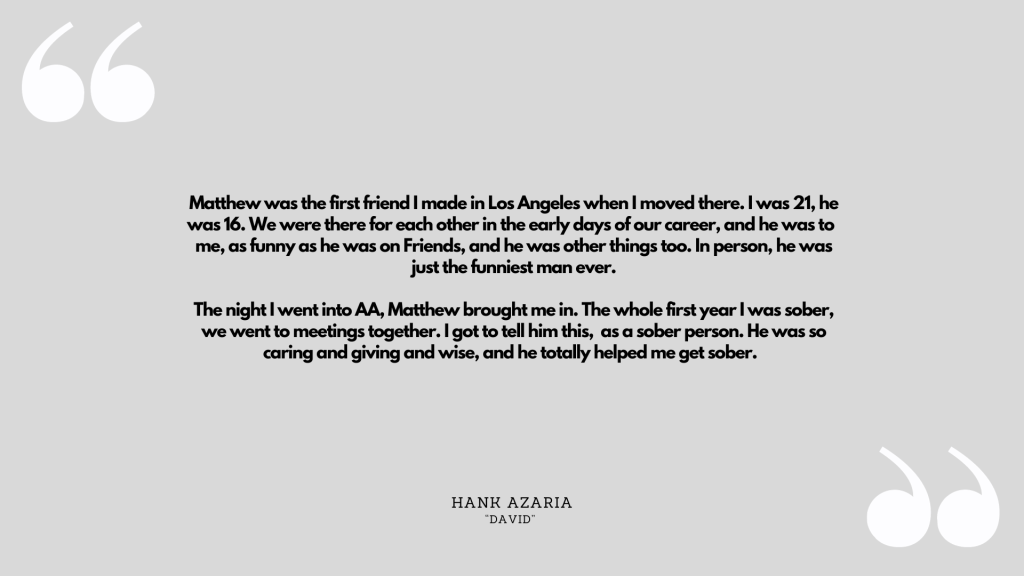


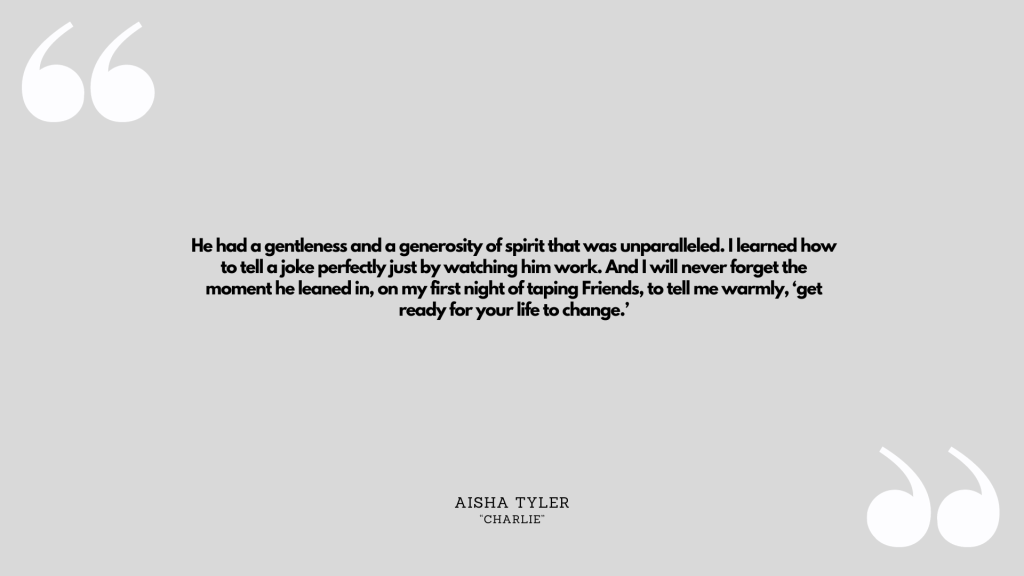
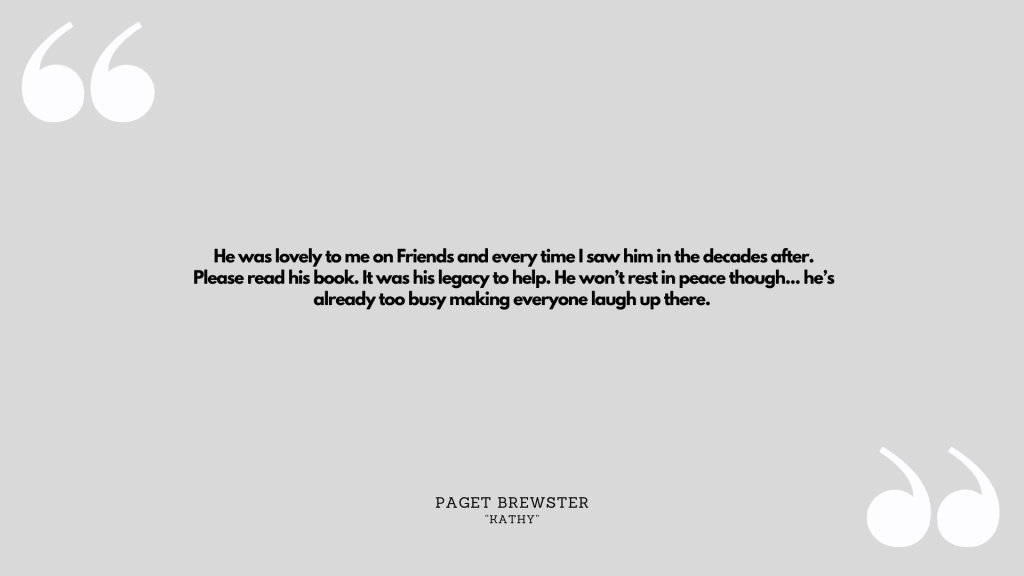

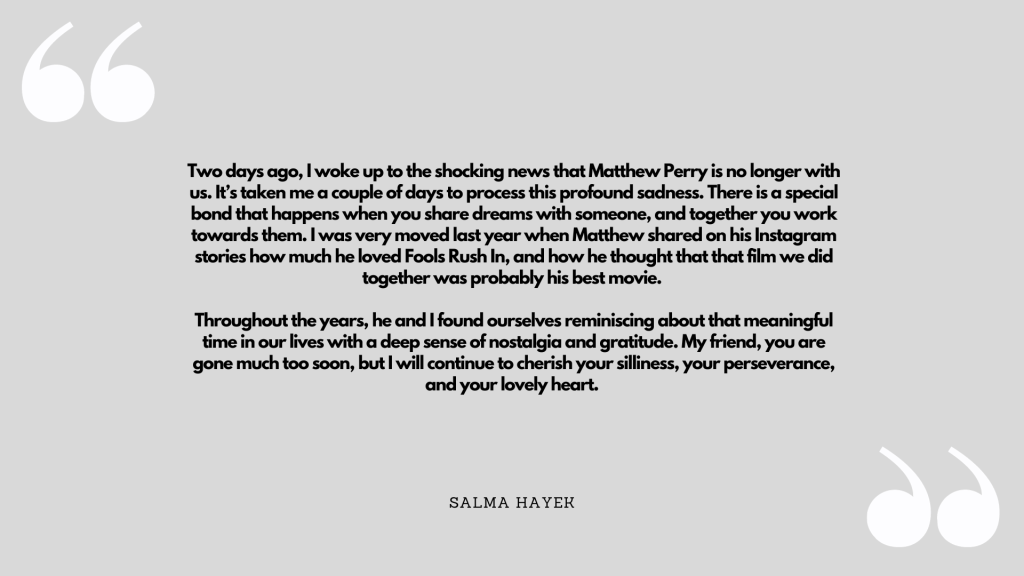

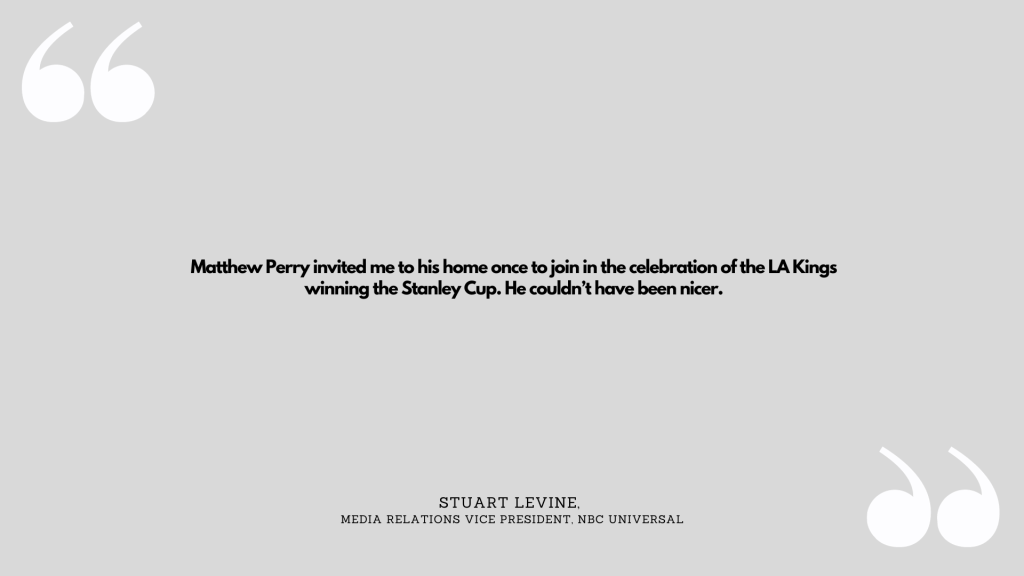
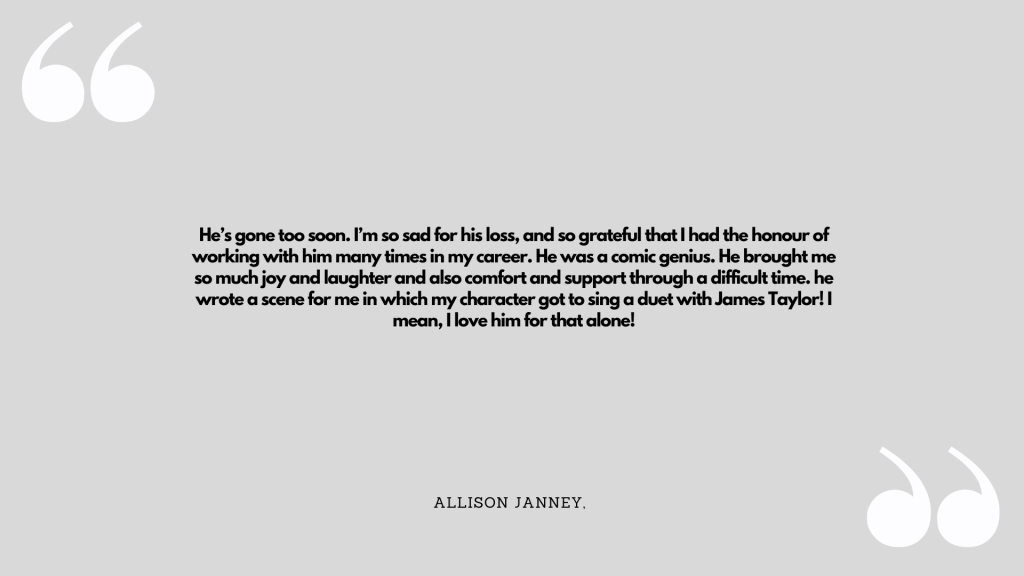

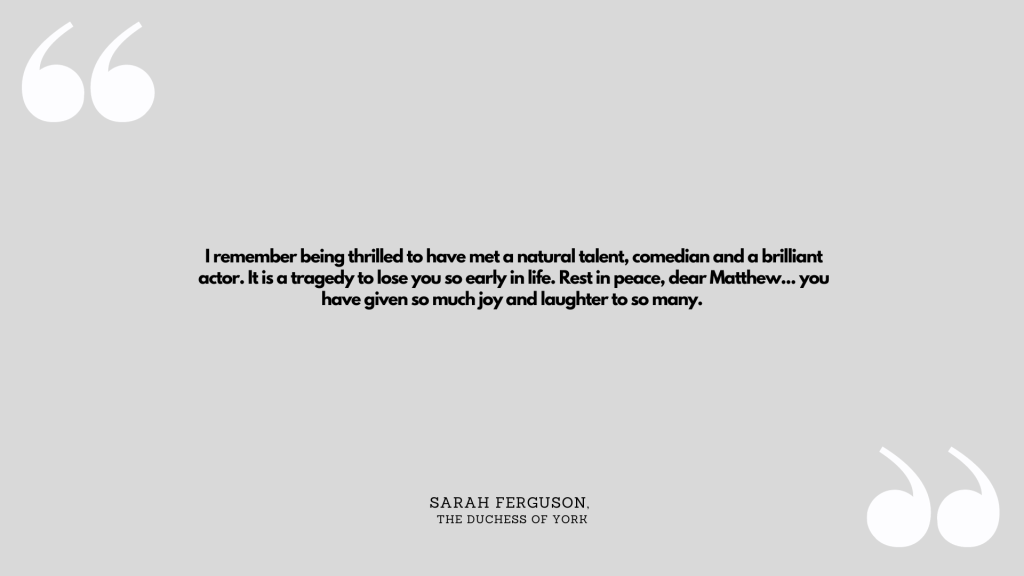
I know that this is a hard time for all of us, but when you feel ready, please read/listen to his book. It’s heart-wrenching, but I am thankful that he got to speak so candidly about his life. I know that for many of us, watching Friends will never be the same again, and if I am being honest, a part of me is tempted to never watch it again because I fear it will make me too sad when I remember what we have lost.
But then, I think, Matthew’s whole purpose was about making people laugh and helping others. He lived for it. And if Friends does both of those things, then doesn’t that mean that as long as we’re watching, his purpose and legacy lives forever, within all of us?
The world is a little less funny without him in it, and I am devastated that he never got his happily ever after when he fought so hard to survive. But, I hope that after all these years, he finally has the peace he so desperately yearned for.
So, while I and the rest of the world sit quietly in our grief, I will also take this opportunity to say thank you to Matthew – for our lives simply would not have been the same without him. He was there for us, until the very end.
Matthew Langford Perry.
19th August 1969 – 28th October 2023.

See below for a list of some of Matthew’s achievements, acting credits, and awards/nominations:
He advocated for a rehabilitation-focused sentencing over prison terms for non-violent drug offenders.
- He advocated for a rehabilitation-focused sentencing over prison terms for non-violent drug offenders.
- In 2013, he received the Champion of Recovery Award from the White House for his advocacy efforts.
- He used his book tour in 2022 to help destigmatize addiction and let others know they are not alone.
- Was a a board member of the Ron Clark Academy, an alternative Atlanta middle school for low-income children.
Acting Credits:
- 1988 | A Night in the Life of Jimmy Reardon
- 1989 | She’s Out of Control
- 1989 | Fat Man and Little Boy | Uncredited
- 1994 | Getting In
- 1997 | Fools Rush In
- 1998 | Almost Heroes
- 1999 | Three to Tango
- 2000 | The Whole Nine Yards
- 2000 | The Kid
- 2002 | Serving Sara
- 2004 | The Whole Ten Yards
- 2007 | Numb
- 2009 | Birds of America
- 2009 | 17 Again
- 1979 | 240-Robert | Episode: “Bank Job“
- 1983 | Not Necessarily the News | Episode: “Audrie in Love“
- 1985 | Charles in Charge | Episode: “The Wrong Guy“
- 1986 | Silver Spoons| Episode: “Rick Moves Out“
- 1987-88 | Second Chance/Boys Will Be Boys | 21 Episodes
- 1988 | Dance Til’ Dawn | Television film
- 1989 | Just the Ten of Us | Episode: “The Dinner Test“
- 1988 | Highway to Heaven | 2 episodes
- 1989 | Empty Nest | Episode: “A Day in the Life“
- 1989 | Growing Pains | 3 episodes
- 1990 | Sydney | Series regular; 13 episodes
- 1990 | Who’s the Boss | Episode: “Roomies“
- 1990 | Call Me Anna | Television film
- 1991 | Beverley Hills, 90210 | Episode: “April is the Cruelest Month“
- 1992 | Dream On | Episode: “To the Moon, Alex!“
- 1992 | Sibs | Episode: “What Makes Lily Run“
- 1993 | Deadly Relations | Television film
- 1993 | Home Free | Series regular; 13 episodes
- 1994 | Parallel Lives | Television film
- 1994-2004 | Friends | Main role; 236 episodes
- 1995 | Caroline in the City | Episode: “Caroline and the Folks“
- 1995 | The John Larroquette Show | Episode: “Rachel Redux“
- 1997 | Saturday Night Live | Episode: “Matthew Perry/Oasis“
- 2001 | The Simpsons | Episode: “Treehouse of Horror XII“
- 2002 | Ally McBeal | 2 episodes
- 2003 | The West Wing | 3 episodes
- 2004 | Scrubs | Episode: “My Unicorn“
- 2006 | The Ron Clark Story | Television film
- 2006-2007 | Studio 60 on the Sunset Strip | Series regular; 21 episodes
- 2011 | Children’s Hospital | Episode: “The Black Doctor“
- 2011 | Mr Sunshine | Series regular; 13 episodes
- 2012-2013 | The Good Wife | 4 episodes
- 2012-2013 | Go On | Series regular; 22 episodes
- 2014 | Cougar Town | Episode: “Like a Diamond“
- 2014 | Playhouse Presents | Episode: “The Dog Thrower“
- 2014 | Web Therapy | 2 episodes
- 2015-2017 | The Odd Couple | Series regular; 38 episodes
- 2017 | The Kennedy’s: After Camelot | Television miniseries; 4 episodes
- 2021 | Friends: The Reunion | HBO Max special
Awards and Nominations:
- 2007 | Golden Globe Awards | Best Actor – Miniseries or Television Film | The Ron Clark Story
- 2002 | Emmy Awards | Oustanding Lead Actor in a Comedy Series | Friends
- 2003 | Emmy Awards | Outstanding Guest Actor in a Drama Series | The West Wing
- 2004 | Emmy Awards | Outstanding Guest Actor in a Drama Series | The West Wing
- 2007 | Emmy Awards | Outstanding Lead Actor in a Miniseries or Movie | The Ron Clark Story
- 2021 | Emmy Awards | Outstanding Variety Special | Friends: The Reunion
- 1996 | Screen Actors Guild Awards | Outstanding Performance by an Ensemble in a Comedy Series | Friends
- 1999 | Screen Actors Guild Awards | Outstanding Performance by an Ensemble in a Comedy Series | Friends
- 2000 | Screen Actors Guild Awards | Outstanding Performance by an Ensemble in a Comedy Series | Friends
- 2001 | Screen Actors Guild Awards | Outstanding Performance by an Ensemble in a Comedy Series | Friends
- 2002 | Screen Actors Guild Awards | Outstanding Performance by an Ensemble in a Comedy Series | Friends
- 2003 | Screen Actors Guild Awards | Outstanding Performance by an Ensemble in a Comedy Series | Friends
- 2004 | Screen Actors Guild Awards | Outstanding Performance by an Ensemble in a Comedy Series | Friends
- 2007 | Screen Actors Guild Awards | Outstanding Performance by a Male Actor in a TV Movie/ Miniseries | The Ron Clark Story
- 1996 | American Comedy Awards | Funniest Supporting Male Performer in a TV Series | Friends
- 1998 | American Comedy Awards | Funniest Supporting Male Performer in a TV Series | Friends
- 2013 | Huading Awards | Best Global Actor in a Television Series | Go On
- 2002 | Nickelodeon Kids’ Choice Awards | Favourite TV Actor | Friends
- 2016, 2017 | People’s Choice Awards | Favourite Comedic TV Actor
- 2006 | Satellite Awards | Best Actor in a Series Drama | Studio 60 on the Sunset Strip
- 2004 | Teen Choice Awards | Choice TV Actor – Comedy | Friends
- 2000 | TV Guide Awards | Editor’s Choice | Friends
- 2006 | TV Land Awards | Most Wonderful Wedding | Friends

Welcome.
Hello!
If you’re new here, allow me to introduce myself. I’m Becks.
I’m a bibliophile, I love taking photographs of anything and everything, and I have a mild addiction to iced coffee. I’m an English graduate, and I currently work in the publishing industry – which is SUPER cool, and has allowed me to gain some wonderful skills… but I won’t go on about that too much because this is starting to sound like the personal statement section of a CV.
I originally began this blog back in 2018 with the aim of dedicating it to long in-depth reviews of books that I was reading to follow on from my bookstagram account, @thebookishlifeofbecks.
But, as I’ve gotten older, I have become more in touch with the world, even if sometimes it is so devastating that I feel like escaping it (figuratively, not literally.) I have a space where I can share, debate, encourage, inspire, educate and entertain people. And if I am fortunate enough to be able to do so, then why wouldn’t I?
That’s why I’m starting this blog over from the very beginning. A brand new fresh start.
So, welcome to The Becks Edit.
Buckle up, Buttercups, because our journey is about to begin.
I absolutely love words, so all my of category titles include puns… however, I realise that it might not be entirely obvious where a post is if you’re looking for something specific, so here is a quick breakdown of what you’ll find under each category. You can find all of these pages under the ‘menu’ tab at the side, or you can click the links below 🙂
Archive – All of my posts in chronological order
Anthology – My writing portfolio.
A Review to Kill – Book, film, television, games, and product reviews.
General Relativity – Miscellaneous posts with no definitive category, life updates
It’s All Literary – Reading and book lists, wrap ups, general book/literary related posts
It’s A New Soundtrack – Music related posts!
Lights, Camera, Action! – General film/television related posts.
Oh, Snap! – A gallery of my photography
On The Write Track – Writing prompts, tips, and advice etc.
Student Survival Guide – Guides/Advice for students, including splitting bills at university, essay writing tips, and more!
 thebecksedit.co.uk