So, it’s officially been over a week since NCIS: Tony and Ziva premiered, and truth be told, I’m still processing. I’ve had every single episode on repeat multiple times since 4th September, so much so that I have almost every single scene fully etched into my brain. I’ve watched all four episodes at least six or seven times already because I just can’t get enough – give me a few weeks or so and I’ll very likely be able to recite them all from memory.
As a long time Tiva fan, I had high hopes for this show, as I am sure most of us did, and it’s safe to say that it has already surpassed every expectation. It is far more than I could have ever wanted and wished for, and there are still six episodes to go. Four episodes in and this show is knocking my socks off in ways I couldn’t have imagined. There’s plenty of romance, epic action sequences – car chases, fights and even self-driving killer automobiles (no, I’m not kidding!), and the humour is absolutely spot-on with some of the best one-liners I have ever heard in a show. With quotes like “Does a babushka wear a headscarf?” and “We have friends and family at this wedding. They’re pathetic and fragile,” I have lost count of how many times I’ve cackled out loud, and I find myself grinning ear-to-ear with every episode.
Before the show premiered, I was unsure as to what to expect going into it. With Tony and Ziva being transported into an entirely new setting, it was easy to worry that the chemistry and magic that made them so brilliant on the mothership wouldn’t be the same. But there’s no reason to fear. Their chemistry is undeniable and better in a million and one ways. Everything that made them exciting to watch on the mothership is ever present and in full force, and their spark is sizzling hotter than ever.
I absolutely adore the fact that this show has broken the classic NCIS formula of episodic procedural, and instead allows for a deeper exploration into the relationship between these two characters; something which fans were pleading to have for decades. The flashbacks execute the ‘filling in the gaps’ perfectly – allowing us to see their life as a couple after Ziva reunites with Tony and Tali in Paris, and they slowly reveal what happened with their relationship (and the reason why it broke down), until we find them where they are today: on the run.
You’re probably asking: well, just how different is it to the mothership? The answer: very. The ghastly tangerine walls of the Navy Yard squad room have been replaced with the most beautiful European backdrops, which only serve to enhance the beautiful storytelling and exceptional writing. It’s true, the show is more romantic spy thriller than crime drama, but it is in the best of ways. There is something in this show for absolutely everyone, whether you’re a long time fan or a newcomer being introduced to these characters for the very first time (and if you are brand new, don’t worry – there’s an incredible montage at the beginning of episode 1 to bring you up to speed with the intricate history of these characters.)
If you’re a lifelong ‘Tiva’ lover as they are so eloquently named and the original show stopped feeling like your NCIS after they left (as I read in one review), then this show is without a doubt, 100% for you. Tony and Ziva are still Tony and Ziva, but are supported by a wonderful ensemble of new characters that are so easy to fall in love with. It’s action-packed, romantic and charmingly persuasive, and it truly feels like they’ve captured lightning in a bottle.
[I’ll also be breaking down every individual episode with my thoughts – as when I my brain starts functioning again!]
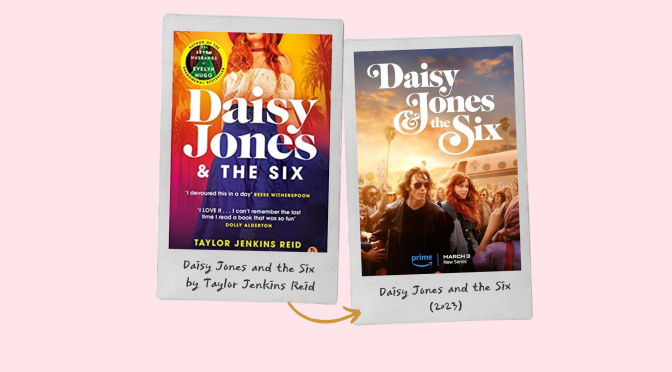
When the news broke that Daisy Jones and the Six was going to be made into a miniseries, I couldn’t wait. While the book was not my favourite, I was excited at the prospect of the adaptation. As the novel is written as an interview with the members after the band’s breakup, documenting their journey from the beginning, to their success, and their downfall, I envisioned that the whole story would be brought to life on screen in the way that a book cannot do. Being able to physically hear the dialogue of these characters if they were being interviewed would make it feel so real that it would be impossible to remember that they’re fictional.
I was expecting to be blown away, and yet, I got two episodes into the series and I found myself not liking it at all.
Often people say that reading a book before watching the film/series can be somewhat of a curse. Readers tend to build up an image of what things look like in their head, and many times what they picture – in terms of characters and settings – never make it onto the big screen. Which, I found was the case with Daisy Jones.
Firstly, I think the casting directors did an excellent job choosing Riley Keough for the role, because she perfectly captures the chaotic mess that is Daisy , and I don’t think I could have selected anybody better for the part. Riley was exactly how I pictured Daisy to look, with her flaming red hair, and exquisite features, even before the adaptation was announced. However, when it comes to other characters – Billy Dunn, Camila, etc. there was just something that didn’t quite hit the mark for me. Of course, I have nothing against the actors chosen for these roles – and I think Sam Claflin is a brilliant actor in his own right, but I imagined Billy with a Kurt Cobain look/vibe and he didn’t scream Billy to me. And while I wasn’t disappointed with Suki Waterhouse, she just wasn’t the Karen I had imagined in my head.
But, truthfully, I don’t think the casting was the problem for me, as even if the characters don’t look exactly as I imagine, I can usually get on board with their performances, especially if they’re good ones.
In fact, I think the whole thing was just way too slow. I know from reading the book that it isn’t the most fast-paced narrative, but literally nothing happens in the first two episodes of the series. I kept watching, and waiting, and yet, I got to the end of each and found myself disappointed. In the book, Daisy and the band meet relatively quickly into the story, and yet, at the end of the second installment their paths still hadn’t crossed. While I think background is important with stories set in previous eras as historical context is important, there was just way too much in these episodes and not enough plot pushing the story forward. I wanted more and wanted something to keep me interested, but my intrigue faded rather fast, hence why I finished the second episode and made it no further.
But, I have to admit that the soundtrack is FIRE. “…Regret Me” and “Look At Us Now (Honeycomb)” are two of my absolute favorites, and I adore the fact that they released an album alongside the adaptation, as it really immerses you in the story. I was surprised by how good Sam Claflin is as a singer, and Riley Keough too, though I wasn’t too surprised considering her grandfather was Elvis Presley… music is basically in her genes. Even if you haven’t seen the series or read the book, I highly recommend listening to ‘Aurora’ on Spotify. If you like 70s alternative indie/rock/folk then you’ll love the songs included on the album!
Perhaps it’s a crazy idea, but I feel like this would have made an excellent adaptation in the form of a radio drama or podcast. The mixture of the band interviews and the music would have been brilliant to listen to, without the constraints or needing to include all of the other information like in an audio book, straight from the page.
I have had many people tell me to stick with it because apparently it gets better, but I feel like unless the story is a thriller with massive twists and turns and an excellent payoff, then each episode up until the ‘good bit’ or the part of Daisy Jones that I’m waiting for, feels wasted until that moment. Maybe I’ll try and revisit this again in the future once I get through my lengthy list of other adaptations waiting for me, but for now, the overall series is only getting 2 and a half stars from me.
When I first heard about this film, I expected it to be very similar to other modern biopics like Jobs (2013), Saving Mr Banks (2013), or The Theory of Everything (2014), focusing on the extraordinary tale of one person and their contribution to the world as we know it. I expected to leave the film amazed at the incredible visuals, the uncanny likeness to Freddie Mercury, and the clever use of music – and at a film that tells us more about an incredible man, whose life battling AIDS was very, very private.
Yet, I walked out of the film disappointed. That’s not to say that the film wasn’t good. There were moments that I thought were brilliant, but I’m not sure I would purposely go back and watch it again. For most of it, I felt like I was watching an extended music video. The film lacked in story, and the music was certainly overused.
One of the brilliant things about movies and television is how they can make you really feel something. The combination of a particular image with a specific piano score can evoke one, or multiple feelings such as happiness, sadness, or nostalgia.
A perfect example of this is in Saving Mr Banks:
The instantly recognizable piano score of Chim Chim Cheree, combined with the ‘Winds in the East’ speech, is one of the best examples of how the creative direction and musical score can work in unison to evoke such feelings.
The score is stripped back to be just a piano playing the melody of one of the most notable songs of the Mary Poppins film. The lack of other musical instruments, added riffs and accompaniments, allow the score to be more impactful, creating a beautiful opening and ending to the film, that leaves you teary-eyed and emotional, as you remember your own childhood and the things that you miss.
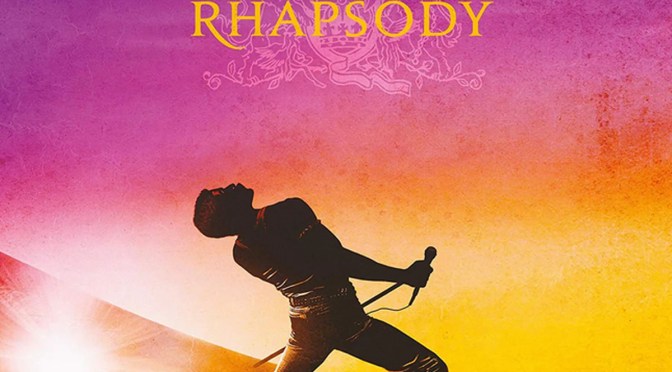
For Bohemian Rhapsody, a movie that documents the life of one of Britain’s most iconic and legendary performers of all time, I expected the film to do something similar. To use creative direction and music to touch the emotions of the audience, to not only remember that man that the world lost but to honour him.
Instead, it was as if the director was attempting to fill the lack of movement in the script with as many Queen songs as possible, in the space of two hours. The majority of the movie is about Queen and their pathway to fame. Nearly every other scene has the band in the recording studio and documents them writing songs in a way that is nowhere near realistic.
Anybody who has ever written anything creative – songs, poetry, fiction, etc. will know that you don’t just have an idea for something, write it down, and that’s that. You work for months, sometimes years, on one project, until you have it exactly the way you imagine it. Writers know that the majority of writing is re-writing. You hate one line, so you change it. And then you hate that, so you change it again. And you keep changing things until you create something so completely different from the idea that you started with, that you end up with something that you love.
But for Queen, in the film, writing songs is as easy as blurting out lyrics. Whatever they say in the moment becomes the final song. There is no changing of lyrics. There are no rewrites. There was no “I hate this melody”, “I don’t think that works”, or “Let’s start this from the very beginning.” They simply churn out albums like a popcorn machine pops kernels.
However, just after Freddie is diagnosed with AIDS he is staring at himself in the mirror, as he examines what is left of himself, knowing that he is going to die from the disease someday, if not very soon. As he stares at himself, a stripped-down version of Who Wants To Live Forever (those specific lyrics) starts playing in the background. This combination of him looking at himself, knowing that his time is limited, and the lyrics and melody of the song, brought a tear to my eye and goosebumps to my skin; and is one of the only moments in this film that has resonated with me, long after the credits rolled.
For a film set within the 1970s and 80s – decades which are known for their promiscuity, such as heavy drug-taking, drinking, and sex, I was expecting there to be multiple, and possibly graphic, sex scenes. Yet, for a film that documents the edgy years of modern society, the edgiest parts of the film are comprised of the drug taking at parties, drinking (which features quite heavily throughout), smoking, and the use of strong language; and several racial slurs. Needless to say, I was pleasantly surprised.
Albeit, one of the most astonishing things about this movie is Rami Malek and his incredible likeness to Freddie Mercury. In a movie that is mediocre for what it is, Malek is an absolute star. Throughout the film, he delivers golden nuggets of one-liners such as “I pity your wife if she thinks that six minutes is forever” (when referring to the song Bohemian Rhapsody), which not only makes the audience laugh but captures the charming, lavish persona that was Mercury.
Yet, throughout the film, there is an overwhelming sense from the audience, that they long to discover who Freddie Mercury was as a human being, not just as a performer. I expected the film to boldly go where no filmmakers have ever gone before, and explore in more depth Freddie’s personal life, such as his closeted sexuality, his hedonism, and his off-stage persona. In a generation where film, television, and media are openly discussing subjects which were previously considered taboo, the film could have been a groundbreaking opportunity for its creators to have generated awareness and educated audiences on HIV and AIDS, as well as put into perspective just how far medical research and treatment has come for these diseases over the last thirty years. Yet, the film merely alludes to the fact that Freddie has AIDS when the audience sees him talking to a doctor in the hospital and sees other sick men with the disease. But not once, are the words “You have AIDS” ever spoken.
Though, despite this missed opportunity, Malek’s performance as Freddie really comes to life, during the final scene of the film, where Queen is performing at Live Aid in 1985. Every movement that Rami Malek makes, every step, every turn of his head, and every facial expression is uncannily similar to that of Freddie Mercury, and it is clear that Malek spent countless hours studying everything about the legendary performer.
The film lacks in multiple aspects, for the most part perhaps because of the change in director halfway through production, the lack of story in the script, or the overuse of music. More could have been done with the musical score and creative direction to evoke an atmosphere and create moments throughout the film that resonated with a nostalgic, emotional audience; and the filmmakers missed an opportunity to create a platform for the discussion of sexually transmitted diseases. However in what is an average film at best, Rami Malek’s uncanny performance as Freddie Mercury is exquisite, and it is almost impossible to envision anybody else fulfilling the role like he does – particularly in the final moments, as he performs on stage as Freddie during Live Aid 1985, which is by far the most brilliant and powerful moment of the whole movie.
Release Date: 24 October 2018 Director(s): Bryan Singer, Dexter Fletcher Distributed by: 20th Century Fox Run Time: 2 hours 14 minutes Starring: Rami Malek, Lucy Boynton, Gwilym Lee, Ben Hardy, Joe Mazzello, Aidan Gillen, Tom Hollander, Mike Myers


 thebecksedit.co.uk